
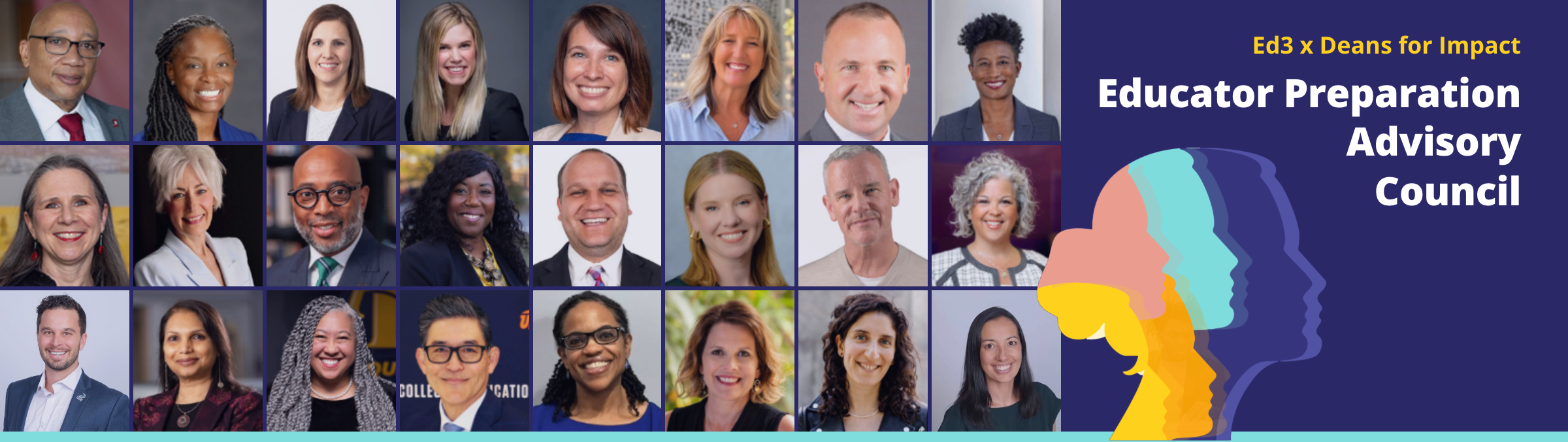
Ed3, a nonprofit whose pedagogy-first AI courses have drawn more than 20,000 educator enrollments, has launched the Educator Preparation Advisory Council (EPAC) with Deans for Impact (DFI). The council brings 22 leaders from colleges of education, community colleges, teacher residencies, and national associations into Ed3's Portrait of a Teacher in the Age of AI, a multi-year research initiative supported by LearnerStudio and the Gates Foundation. DFI's full press release is available at deansforimpact.org/epac-announcement.
Two councils, one teacher pipeline
The Portrait of a Teacher project studies how the teaching role is changing as AI spreads through schools. It is building forward-looking, adaptive frameworks and tools that schools, districts, and preparation programs can use to define the competencies, mindsets, and roles teachers will need.
A K-12 Advisory Council of more than 40 partner organizations, including Pearson, Google, Digital Promise, ISTE, ETS, Teach For America, and district superintendents, has guided the project's view of what schools and students will need from teachers. EPAC adds the programs responsible for preparing and credentialing those teachers. With both councils at the table, what districts expect of new teachers and how programs prepare them can develop in step.
"AI gives us an opportunity to fundamentally rethink the teaching profession, instead of simply making existing practices more efficient. The question isn't just how we prepare teachers to use AI, but how we prepare them to make sound decisions about when, why, and whether AI belongs in learning. Those decisions have profound implications for students' critical thinking, agency, and human connection. If we're reimagining what we expect of teachers, we must also reimagine how we prepare them. That's why teacher preparation leaders need a voice in shaping the future of the profession."
~ Vriti Saraf, Co-Founder and CEO of Ed3 Global
What the council will do
Council members will review the project's research agenda and give feedback on emerging guidance about how teacher competencies, responsibilities, and talent pipelines should evolve. That guidance is meant to help preparation programs, districts, policymakers, and others develop teachers who are ready for their own contexts and students, while keeping human relationships and judgment at the center of the work.
EPAC held its first meeting on October 29, 2026 and will continue to meet quarterly, with chances to join conversations with the K-12 Advisory Council.
DFI's work on AI and teacher preparation
For DFI, the council builds on its focus on student learning and instructional quality in teacher preparation. Earlier this year DFI released the second edition of The Science of Learning, its report applying cognitive science research to teaching practice. It is also developing a framework with TeachingWorks that sets out the competencies novice teachers need to use strong instructional judgment in AI-enabled classrooms.
"As AI shifts how teachers and students engage in learning, we remain steadfast in ensuring that the decisions teachers, leaders, and policymakers make are rooted in what's best for supporting student learning. We are excited to partner with Ed3 to ensure that leaders in higher education and educator preparation have a voice at the table. We believe Ed3 and these council members are the right people to tackle hard questions about how to prepare teachers to make sound instructional decisions if and when AI tools are used in classrooms."
~ Valerie Sakimura, CEO of Deans for Impact
Council members
- Robert Q. Berry III, Dean, School of Education, Indiana University Bloomington
- Neporcha Cone, Dean, College of Education, Middle Tennessee State University
- Leslie Cowell, Dean and Professor, College of Education, Lipscomb University (TN)
- Meredith Critchfield, Dean, College of Education, Grand Canyon University (AZ)
- Sara DeLano, Dean, School of Education, Dallas College (TX)
- Julie Ferin, Executive Director, National Association of Community College Teacher Education Programs (NACCTEP)
- Ryan Evely Gildersleeve, Dean, College of Education, Eastern Michigan University
- Kimberly Griffin, Dean, College of Education, University of Maryland, College Park
- Cathy Horn, Dean, College of Education, University of Houston (TX)
- Lisa Hunter, Associate Vice President for Academic Innovation and Transformation, American Association of State Colleges and Universities (AASCU)
- Jerlando F.L. Jackson, Dean, College of Education, Michigan State University
- Gaëtane Jean-Marie, Dean, College of Education, Rowan University (NJ)
- Cullen Johnson, Director of Education, Memphis Teacher Residency (TN)
- Sarah Johnson, President and CEO, Relay Graduate School of Education
- Jim Meadows, Dean and Director, Educator Career Pathways Center, Washington Education Association (WEA-ART)
- Colleen Mulholland, Dean, College of Education; Richard O. Jacobson Endowed Chair of Leadership in Education, University of Northern Iowa
- Rene Parmar, Dean, School of Education, State University of New York (SUNY) at New Paltz
- Paula Groves Price, Dean, College of Education, North Carolina A&T State University
- Clif Tanabe, Vice Provost for Learning Innovation and Dean, College of Education, University of Texas at El Paso
- Carolyn Theard-Griggs, Dean, National College of Education, National Louis University (IL)
- Nicole Thompson, Vice Dean, Division for Advancing Educator Preparation, Mary Lou Fulton College for Teaching and Learning Innovation, Arizona State University
- Sara Vogel, Research Director, Computing Integrated Teacher Education (CITE), City University of New York (CUNY)
Research from the project, including a synthesis of 25 studies on teacher AI adoption and a national survey of more than 1,100 educators, is available at ed3global.org/teacherportrait. Anyone can follow the work by joining the project's Brain Trust, which shares quarterly updates and gathers feedback from nearly 950 researchers, policymakers, funders, and educators.


