The Portrait of a Teacher in the Age of AI
.png)



How will the role of a teacher evolve in a world transformed by AI?
The Portrait of a Teacher (PoT) project aims to understand how the role of educators is evolving in response to the rapid technological and workforce changes shaping society.
Recognizing that the teaching profession has historically remained stagnant and that burnout and attrition are high, the project proposes building a set of forward-looking, adaptable frameworks and tools that guide the creation of competencies, mindsets, and roles that educators need to thrive in the AI era.
Phase 1 of this project is focused on the United States and involves three research strands.

Artifacts:
Each research strand produces artifacts that are published as the work develops, rather than held until project completion. This reflects a core commitment of the initiative: to build knowledge in public and invite engagement throughout. Artifacts will be linked on this roadmap as they are released. We welcome feedback through the Brain Trust.


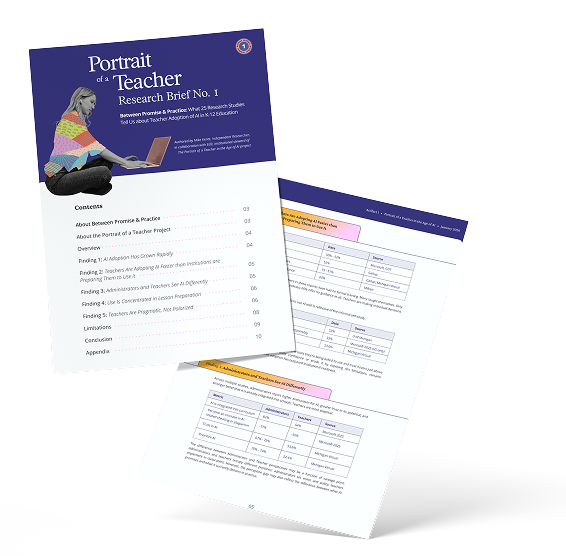

What 25 Research Studies Tell Us about Teacher Adoption of AI in K-12 Education
View PDF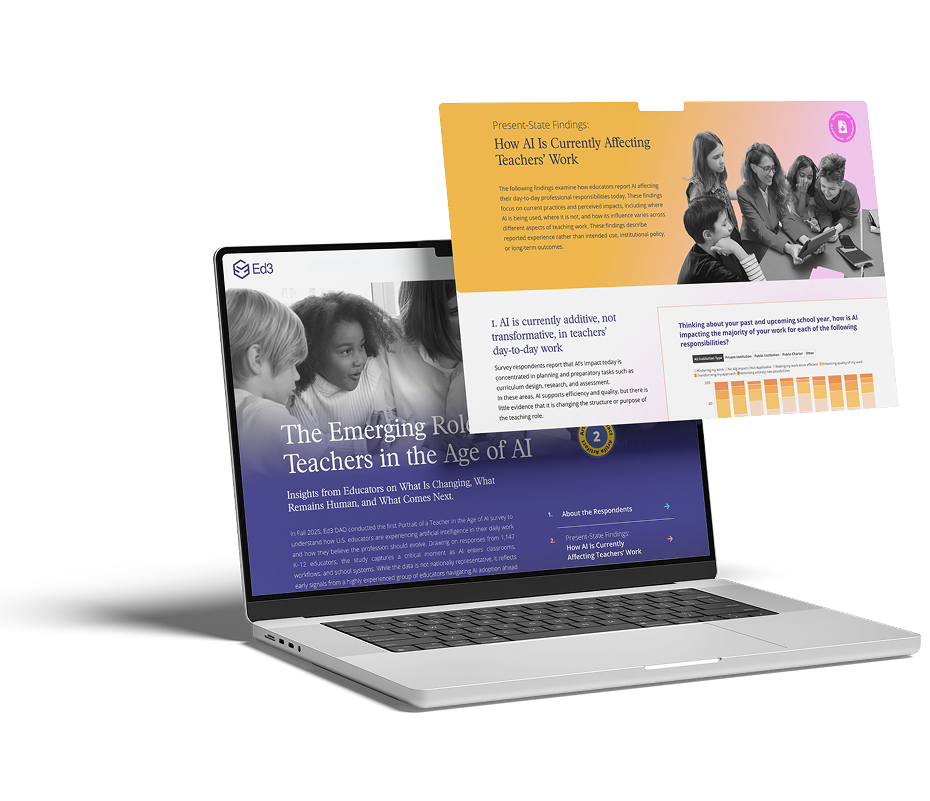
Insights from Educators on What is Changing, What Remains Human, and What Comes Next.
View Interactive Report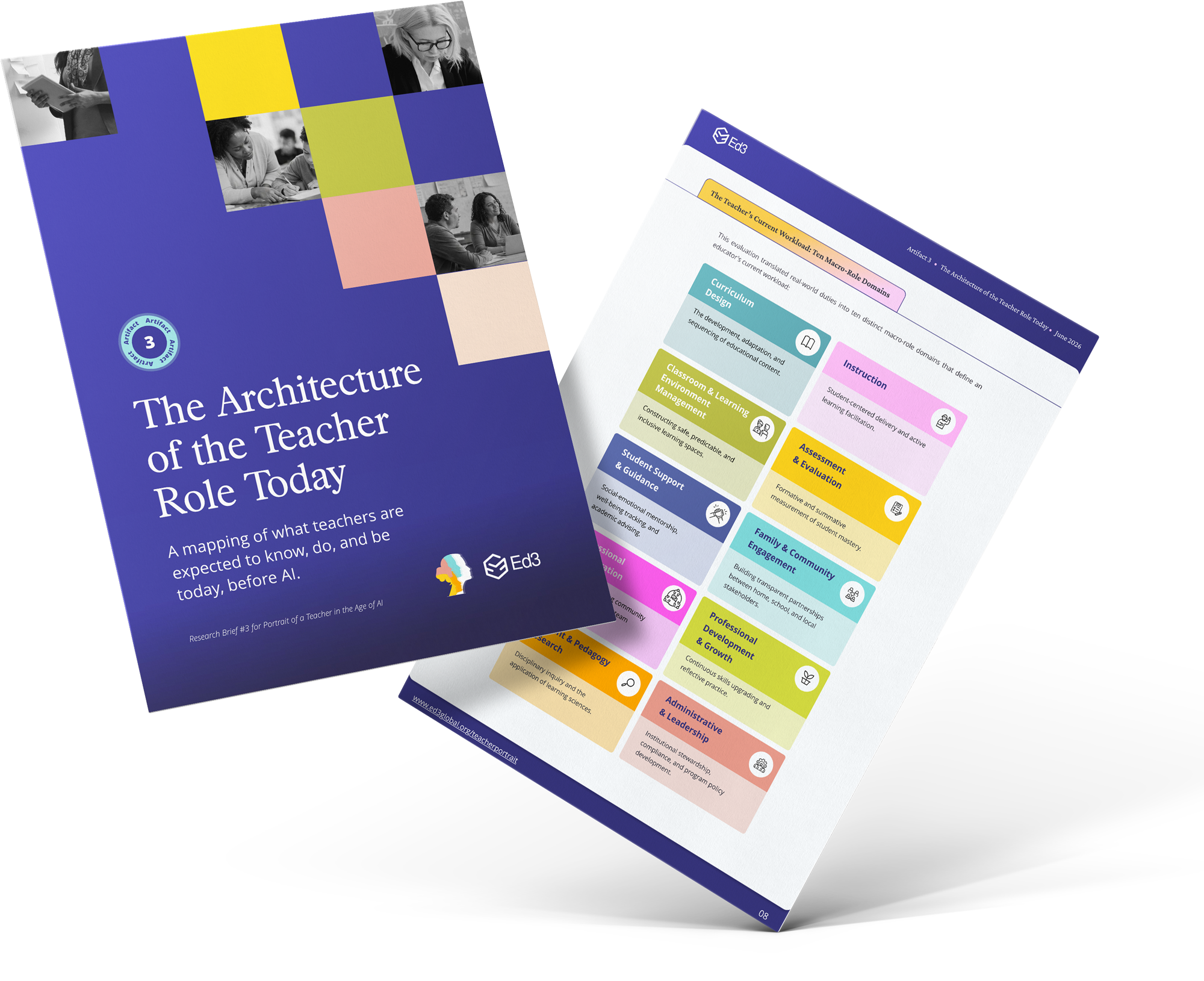
A mapping of what teachers are expected to know, do, and be today, before AI.
View PDF


The Architecture of the Teacher Role Today
A mapping of what teachers are expected to know, do, and be today, before AI.
View PDFEmerging Role of Teachers in the Age of AI
Insights from Educators on What is Changing, What Remains Human, and What Comes Next.
View Interactive ReportBetween Promise and Practice
What 25 Research Studies Tell Us about Teacher Adoption of AI in K-12 Education
View PDF
Advisory Council:
The Portrait of a Teacher initiative is guided by leaders whose expertise and networks span the education and technology landscape. Council members bring strategic direction to the research and contribute to shaping the vision for what it means to teach and lead in the age of AI.







.png)






















.png)



.png)

.jpg)










.png)


Join the Brain Trust
Join a global community of professionals across the full education ecosystem shaping what it means to teach in the age of AI. Every Brain Trust member directly influences our research, ensuring the Portrait stays grounded in classroom realities, responsive to future needs, and aligned with societal and workforce demands. Your contribution matters and comes with unique opportunities:

Review draft frameworks and participate in surveys and interviews that directly inform what the Portrait becomes.

Receive findings, tools, and reports before public release.

Receive credit in public-facing materials and compensation for deeper engagements.
Resources from across the field:
Redefining the teacher role for the age of AI requires collective effort. Here we curate resources from organizations across the field, especially from our Advisory Council members, whose work complements, challenges, and extends this research.
.png)
This qualitative study of 20 AI products across 32 classrooms strongly corroborates PoT's core finding that teachers remain central and AI adoption is not yet transformative: the report states plainly that nothing observed suggests AI tools are positioned to replace educators as the driver of learning. It carries direct practitioner signal from over 50 teachers and 25 school/system leaders on what they value (fast, individualized feedback; time back for high-value work) and what concerns them (chatbot-enabled shortcuts, inconsistent implementation). As a framing source, its finding that "implementation matters as much as product design" and its three-part product typology (general-purpose chatbots, multipurpose platforms, targeted instructional tools) offer useful language for how Strand 2 might describe the conditions under which AI does or doesn't reshape a given responsibility. It also names a gap relevant to PoT: most products are not designed to support instructional coaches or school leaders, despite leader involvement mattering significantly to consistent use. Note on scope: this is a qualitative, non-random sample (20 products selected for range, not for representativeness) intended to illustrate patterns rather than establish causal impact

.png)
This 2026 Common Sense Media survey of 1,017 U.S. teens found that 70% use AI for schoolwork, mostly to get or check answers rather than for deeper learning. Teens rank interpersonal and critical-thinking skills above AI literacy for their future, and most turn to a person before AI when stuck. Major gaps include unclear school AI rules and little teacher discussion of AI safety or literacy. For PoT, this corroborates the efficiency/transformation distinction from the student side and gives Strand 2 evidence on which responsibilities (AI literacy instruction) educators aren't yet taking up. It also names a gap in shared language for guiding AI use that mirrors PoT's competency framework goals, and its "spectrum of getting an answer" offers a useful reference for Strand 3 survey design. Note on scope: this resource draws on a survey of 1,017 U.S. teens, ages 13-17.

This study is directly relevant to Strand 3's focus on young people's relationships with relational AI. The finding that 65% of girls who use voice-assisted devices see them as friends - rising to 51% who have asked AI for help when sad, anxious, or lonely among ages 11-13 - is concrete evidentiary support for PoT's claim that artificial relationships are already a present-tense reality in learners' lives. The perception gap between parents and girls (51% of girls use AI daily; only 32% of parents recognize this) and the parental unpreparedness finding (56% feel unequipped to guide safe AI use) speak to the educator role in mediating these dynamics. The study also corroborates the ecosystem signal framing: this is a pattern-of-adoption story with both bright spots and risk indicators. Note on scope: this resource draws on a survey of 1,000 girls and 1,000 parents.
This CRPE brief corroborates PoT's Strand 1 finding that AI adoption in K-12 is additive rather than transformative, describing the field as still in the 'lightbulb stage' where efficiency gains are visible but structural redesign is absent. The supply-demand mismatch it identifies (developers building point solutions while districts lack clear vision) directly supports PoT's argument that the field needs shared frameworks and language. As a gap identifier, the brief is explicit: AI tools are not addressing students' lack of motivation, social disconnection, or chronic absenteeism, and are not designed for underserved students - gaps that PoT's relational framing speaks to. One complicating note: CRPE's framing is primarily structural and market-oriented, while PoT's framing is role-centered and practitioner-facing. PoT should acknowledge this different vantage point rather than treating them as fully equivalent. Note on scope: this resource draws on semi-structured interviews with approximately 50 stakeholders recruited through snowball sampling.

This compilation of essays surfaces alignment across organizations (relationships are irreducible, learner agency is the goal, AI raises the stakes) alongside tensions, including how much transformation is achievable inside existing systems and what rigor should mean. The competencies and role descriptions these six organizations articulate offer a benchmarking reference for PoT's Strand 2 framework, both for alignment and for identifying where PoT's AI-specific lens adds something the field has not yet named. The document's honest treatment of disagreement across organizational models is also relevant to how PoT positions its own competency framework as contextually adaptable rather than fixed. Note on scope: this resource draws on structured written essays and exchanges among six organizations operating outside or at the edges of traditional schooling.
This is the source of the three-subcategory taxonomy (general chatbots, anthropomorphic AI companions, mental health AI platforms) that loosely structures Strand 3's framing. The Relational Intelligence quiz an adjacent artifact that operationalizes the concept of relational intelligence as a measurable, developable capacity. This resource is both a framing source (relational intelligence as a concept PoT may want to engage or cite) and a collaboration seed (a concrete tool that could be integrated into the Portrait Toolkit or used to inform how PoT frames educator competencies around navigating artificial relationships).

This white paper directly addresses the replacement narrative that PoT is also contesting, and provides a well-documented framework of six domains of human expertise in teaching (Learning Progression, Growth and Skill Development, Learner Development and Continuity, Community and Civic Context, Instructional Coherence and Culture, Complex and Specialized Learning Needs). This taxonomy is both a corroborating source and a potential benchmarking reference for PoT's Strand 2 competency framework: PoT can examine where its own framework aligns with, extends, or refines these six domains. The paper's argument that replacement narratives are a symptom of role design failures, not AI capabilities, maps onto PoT's claim that AI adoption is currently additive rather than transformative. The 'Signals from the Field' case studies also offer practitioner evidence that could be woven into PoT publications. Note on scope: this resource draws on six curated practitioner case studies.

This survey maps four distinct clusters of youth AI use from task-based to relational/companionate, and documents the relationship between social connection, loneliness, and high-risk AI behaviors. Its key finding - that feeling genuinely seen and safe protects young people from high-risk AI use - is directly relevant to PoT's argument about the teacher's role in mediating students' relationships with AI. This survey can be paired with PoT's own youth or parent survey to generate comparative findings. Methodologically, its cluster analysis approach and the distinction between social connection variables and high-risk AI use variables offer a model for how PoT might structure its own Strand 3 analysis. Note on scope: this resource draws on a nationally representative survey of 2,383 young people ages 13-24, co-designed with youth fellows and analyzed using hierarchical cluster analysis.

This blog post corroborates PoT's Strand 2 argument that educator roles must be redesigned around distributed expertise and team-based models rather than the 'one teacher, one classroom' structure. The medical team analogy (attending physician, resident, nurse) is a useful framing candidate for describing how differentiated educator roles might function in an AI-enabled ecosystem. The talent pipeline argument (that educators should be able to move in and out of the profession with stackable credentials) is also directly relevant to PoT's competency framework, which aims to help education leaders identify and validate teaching talent in new ways.

This blog post draws directly on PoT's national survey. It describes five roles that teachers themselves identified as the most human parts of their work: builders of wellbeing and belonging, mentors for motivation and character development, designers of personalized learning and feedback, coaches of critical thinking and ethical judgment, and connectors of community and real-world experiences. The post also introduces the Strand 3 question directly, as students turn to AI companions for emotional support, teachers take on new responsibilities for helping learners discern authentic human relationships from artificial ones.

This blog post directly addresses PoT's central question; who counts as an educator, and expands the answer well beyond classroom teachers to include youth workers, mentors, community educators, and employers. This broadening is directly relevant to PoT's Strand 2 work mapping the architecture of the educator role: it argues that the educator ecosystem is already larger than the field formally recognizes, and that AI intensifies the need to name and support this full community. The framing of the 'mesosystem' (the people, places, and possibilities young people navigate daily) could inform how PoT's toolkit is designed to be locally adaptable rather than school-centric.
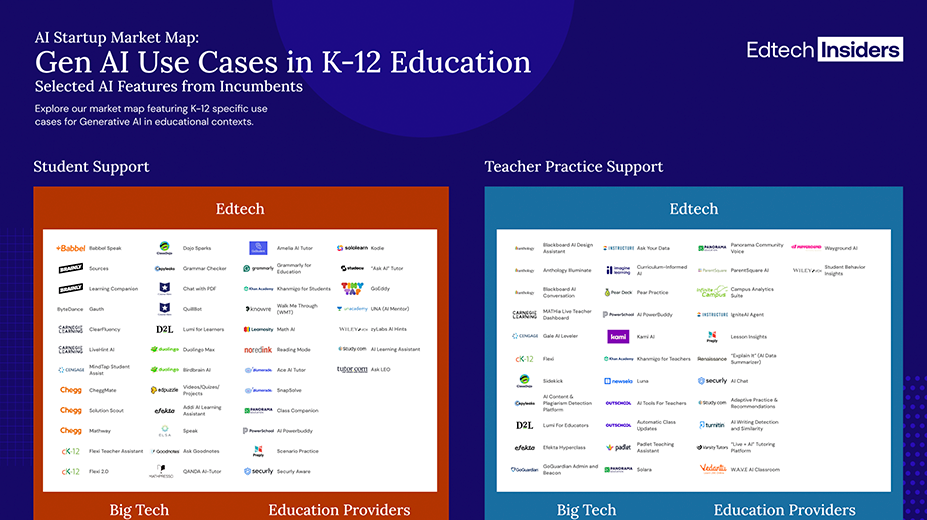
These maps provide a comprehensive snapshot of where the field is currently investing in AI-enabled use cases in K-12. For PoT's ecosystem signals framing in Strand 3, the maps reveal that the majority of AI investment targets back-end teacher tasks and student academic support, with comparatively little targeting the relational and social-emotional dimensions of learning. This gap is precisely what PoT is naming as the under-attended terrain. The maps also serve as benchmarking: PoT's emerging competency framework can be situated against the capabilities these tools assume teachers will need, testing whether those assumptions match what PoT's research surfaces as the evolving educator role.

This report identifies six adult roles: Creativity Catalyst, Transitions Specialist, Reflection Partner, Futures Strategist, Experience Broker, and Foundations Coach. Several of these roles map directly onto responsibilities PoT's research is surfacing as part of the evolving educator role. The framework also corroborates PoT's ecosystem framing: it treats adult support as distributed across multiple roles rather than concentrated in a single teacher figure. Note on scope: this resource draws on a youth co-design process conducted at a single convening with 16 young people.

The 'Human Flourishing in the Age of AI' framework introduced here (positioning a third path between Nostalgic Humanism and Technocentrism) offers a conceptual north star for the PoT project. PoT is contributing to this broader human flourishing agenda through an educator-specific lens. The paper's insistence that AI is already reshaping not just how learning happens but what learners need to know is directly upstream of PoT's claim that the educator role must evolve accordingly. The Humanics curriculum framework (AI literacy + modernized disciplinary knowledge + human literacies) may inform PoT's competency framework. This resource is also a strong literature review anchor for Strand 1.

This survey provides national-scale data on AI adoption, attitudes, and impact that corroborates several of PoT's between-promise-and-practice findings. Its core finding; a 'messy middle' of uneven adoption, insufficient training, and sharp divisions about AI's impact, aligns with PoT's framing of AI adoption as currently additive rather than transformative. Particularly relevant for Strand 2: data on how skills needed at work are shifting (technical skills, adaptability, strategic thinking) and on how workers are self-directed in AI learning rather than guided by institutions. For Strand 3, the finding that AI's impact on learner relationships with peers and teachers is mixed and polarized (roughly equal shares reporting more and less connection) is substantively important. The survey's treatment of equity (women, people without four-year degrees, and early-career workers as differentially vulnerable) also enriches PoT's equity framing. Note on scope: this resource draws on a survey of 3,020 workers and learners conducted in November 2025, with a workforce and career focus rather than a K-12 educator focus.

This convening brief corroborates PoT's central claim that AI adoption in K-12 remains incremental rather than transformative, concentrated in efficiency use cases rather than role redesign. The practitioner voices surfaced at the convening - including tensions between efficiency and transformation, personalization and coherence, and expanded capacity versus educator sustainability - map directly onto tensions PoT's own research is naming. The "looms vs. cranes" metaphor (AI should do what humans can't, not just what they already do) is a strong framing candidate for Strand 2's communication of the educator role. The brief also signals a gap the field is grappling with: the lack of shared language, frameworks, and learning structures to guide responsible experimentation, which is the precise gap PoT's competency framework aims to fill. Note on scope: this resource draws on a two-day facilitated convening of approximately 40 organizations.

This resource connects to Ed3's Portrait of a Teacher project primarily through Strand 2. Its task-level framework for mapping which skills AI will replace, displace, augment, or elevate across occupations offers a methodological reference for how PoT might approach its own architecture of the educator role, particularly in distinguishing which teacher responsibilities are likely to shift versus which will become more essential. As a benchmarking resource, the JFF framework's consistent finding that interpersonal and relational skills are the most AI-resilient across all industries corroborates a central claim PoT is making specifically about teaching. Note on scope: this resource draws on a workforce-wide analysis of occupational task data published in 2023, with a focus on industries broadly rather than K-12 education specifically. It is useful for situating PoT's work within a broader national conversation about AI and professional roles.

This qualitative study of 20 AI products across 32 classrooms strongly corroborates PoT's core finding that teachers remain central and AI adoption is not yet transformative: the report states plainly that nothing observed suggests AI tools are positioned to replace educators as the driver of learning. It carries direct practitioner signal from over 50 teachers and 25 school/system leaders on what they value (fast, individualized feedback; time back for high-value work) and what concerns them (chatbot-enabled shortcuts, inconsistent implementation). As a framing source, its finding that "implementation matters as much as product design" and its three-part product typology (general-purpose chatbots, multipurpose platforms, targeted instructional tools) offer useful language for how Strand 2 might describe the conditions under which AI does or doesn't reshape a given responsibility. It also names a gap relevant to PoT: most products are not designed to support instructional coaches or school leaders, despite leader involvement mattering significantly to consistent use. Note on scope: this is a qualitative, non-random sample (20 products selected for range, not for representativeness) intended to illustrate patterns rather than establish causal impact
This 2026 Common Sense Media survey of 1,017 U.S. teens found that 70% use AI for schoolwork, mostly to get or check answers rather than for deeper learning. Teens rank interpersonal and critical-thinking skills above AI literacy for their future, and most turn to a person before AI when stuck. Major gaps include unclear school AI rules and little teacher discussion of AI safety or literacy. For PoT, this corroborates the efficiency/transformation distinction from the student side and gives Strand 2 evidence on which responsibilities (AI literacy instruction) educators aren't yet taking up. It also names a gap in shared language for guiding AI use that mirrors PoT's competency framework goals, and its "spectrum of getting an answer" offers a useful reference for Strand 3 survey design. Note on scope: this resource draws on a survey of 1,017 U.S. teens, ages 13-17.
This study is directly relevant to Strand 3's focus on young people's relationships with relational AI. The finding that 65% of girls who use voice-assisted devices see them as friends - rising to 51% who have asked AI for help when sad, anxious, or lonely among ages 11-13 - is concrete evidentiary support for PoT's claim that artificial relationships are already a present-tense reality in learners' lives. The perception gap between parents and girls (51% of girls use AI daily; only 32% of parents recognize this) and the parental unpreparedness finding (56% feel unequipped to guide safe AI use) speak to the educator role in mediating these dynamics. The study also corroborates the ecosystem signal framing: this is a pattern-of-adoption story with both bright spots and risk indicators. Note on scope: this resource draws on a survey of 1,000 girls and 1,000 parents.
This CRPE brief corroborates PoT's Strand 1 finding that AI adoption in K-12 is additive rather than transformative, describing the field as still in the 'lightbulb stage' where efficiency gains are visible but structural redesign is absent. The supply-demand mismatch it identifies (developers building point solutions while districts lack clear vision) directly supports PoT's argument that the field needs shared frameworks and language. As a gap identifier, the brief is explicit: AI tools are not addressing students' lack of motivation, social disconnection, or chronic absenteeism, and are not designed for underserved students - gaps that PoT's relational framing speaks to. One complicating note: CRPE's framing is primarily structural and market-oriented, while PoT's framing is role-centered and practitioner-facing. PoT should acknowledge this different vantage point rather than treating them as fully equivalent. Note on scope: this resource draws on semi-structured interviews with approximately 50 stakeholders recruited through snowball sampling.
This compilation of essays surfaces alignment across organizations (relationships are irreducible, learner agency is the goal, AI raises the stakes) alongside tensions, including how much transformation is achievable inside existing systems and what rigor should mean. The competencies and role descriptions these six organizations articulate offer a benchmarking reference for PoT's Strand 2 framework, both for alignment and for identifying where PoT's AI-specific lens adds something the field has not yet named. The document's honest treatment of disagreement across organizational models is also relevant to how PoT positions its own competency framework as contextually adaptable rather than fixed. Note on scope: this resource draws on structured written essays and exchanges among six organizations operating outside or at the edges of traditional schooling.
This is the source of the three-subcategory taxonomy (general chatbots, anthropomorphic AI companions, mental health AI platforms) that loosely structures Strand 3's framing. The Relational Intelligence quiz an adjacent artifact that operationalizes the concept of relational intelligence as a measurable, developable capacity. This resource is both a framing source (relational intelligence as a concept PoT may want to engage or cite) and a collaboration seed (a concrete tool that could be integrated into the Portrait Toolkit or used to inform how PoT frames educator competencies around navigating artificial relationships).
This white paper directly addresses the replacement narrative that PoT is also contesting, and provides a well-documented framework of six domains of human expertise in teaching (Learning Progression, Growth and Skill Development, Learner Development and Continuity, Community and Civic Context, Instructional Coherence and Culture, Complex and Specialized Learning Needs). This taxonomy is both a corroborating source and a potential benchmarking reference for PoT's Strand 2 competency framework: PoT can examine where its own framework aligns with, extends, or refines these six domains. The paper's argument that replacement narratives are a symptom of role design failures, not AI capabilities, maps onto PoT's claim that AI adoption is currently additive rather than transformative. The 'Signals from the Field' case studies also offer practitioner evidence that could be woven into PoT publications. Note on scope: this resource draws on six curated practitioner case studies.
This survey maps four distinct clusters of youth AI use from task-based to relational/companionate, and documents the relationship between social connection, loneliness, and high-risk AI behaviors. Its key finding - that feeling genuinely seen and safe protects young people from high-risk AI use - is directly relevant to PoT's argument about the teacher's role in mediating students' relationships with AI. This survey can be paired with PoT's own youth or parent survey to generate comparative findings. Methodologically, its cluster analysis approach and the distinction between social connection variables and high-risk AI use variables offer a model for how PoT might structure its own Strand 3 analysis. Note on scope: this resource draws on a nationally representative survey of 2,383 young people ages 13-24, co-designed with youth fellows and analyzed using hierarchical cluster analysis.
This blog post corroborates PoT's Strand 2 argument that educator roles must be redesigned around distributed expertise and team-based models rather than the 'one teacher, one classroom' structure. The medical team analogy (attending physician, resident, nurse) is a useful framing candidate for describing how differentiated educator roles might function in an AI-enabled ecosystem. The talent pipeline argument (that educators should be able to move in and out of the profession with stackable credentials) is also directly relevant to PoT's competency framework, which aims to help education leaders identify and validate teaching talent in new ways.
This blog post draws directly on PoT's national survey. It describes five roles that teachers themselves identified as the most human parts of their work: builders of wellbeing and belonging, mentors for motivation and character development, designers of personalized learning and feedback, coaches of critical thinking and ethical judgment, and connectors of community and real-world experiences. The post also introduces the Strand 3 question directly, as students turn to AI companions for emotional support, teachers take on new responsibilities for helping learners discern authentic human relationships from artificial ones.
This blog post directly addresses PoT's central question; who counts as an educator, and expands the answer well beyond classroom teachers to include youth workers, mentors, community educators, and employers. This broadening is directly relevant to PoT's Strand 2 work mapping the architecture of the educator role: it argues that the educator ecosystem is already larger than the field formally recognizes, and that AI intensifies the need to name and support this full community. The framing of the 'mesosystem' (the people, places, and possibilities young people navigate daily) could inform how PoT's toolkit is designed to be locally adaptable rather than school-centric.
These maps provide a comprehensive snapshot of where the field is currently investing in AI-enabled use cases in K-12. For PoT's ecosystem signals framing in Strand 3, the maps reveal that the majority of AI investment targets back-end teacher tasks and student academic support, with comparatively little targeting the relational and social-emotional dimensions of learning. This gap is precisely what PoT is naming as the under-attended terrain. The maps also serve as benchmarking: PoT's emerging competency framework can be situated against the capabilities these tools assume teachers will need, testing whether those assumptions match what PoT's research surfaces as the evolving educator role.
This report identifies six adult roles: Creativity Catalyst, Transitions Specialist, Reflection Partner, Futures Strategist, Experience Broker, and Foundations Coach. Several of these roles map directly onto responsibilities PoT's research is surfacing as part of the evolving educator role. The framework also corroborates PoT's ecosystem framing: it treats adult support as distributed across multiple roles rather than concentrated in a single teacher figure. Note on scope: this resource draws on a youth co-design process conducted at a single convening with 16 young people.
The 'Human Flourishing in the Age of AI' framework introduced here (positioning a third path between Nostalgic Humanism and Technocentrism) offers a conceptual north star for the PoT project. PoT is contributing to this broader human flourishing agenda through an educator-specific lens. The paper's insistence that AI is already reshaping not just how learning happens but what learners need to know is directly upstream of PoT's claim that the educator role must evolve accordingly. The Humanics curriculum framework (AI literacy + modernized disciplinary knowledge + human literacies) may inform PoT's competency framework. This resource is also a strong literature review anchor for Strand 1.
This survey provides national-scale data on AI adoption, attitudes, and impact that corroborates several of PoT's between-promise-and-practice findings. Its core finding; a 'messy middle' of uneven adoption, insufficient training, and sharp divisions about AI's impact, aligns with PoT's framing of AI adoption as currently additive rather than transformative. Particularly relevant for Strand 2: data on how skills needed at work are shifting (technical skills, adaptability, strategic thinking) and on how workers are self-directed in AI learning rather than guided by institutions. For Strand 3, the finding that AI's impact on learner relationships with peers and teachers is mixed and polarized (roughly equal shares reporting more and less connection) is substantively important. The survey's treatment of equity (women, people without four-year degrees, and early-career workers as differentially vulnerable) also enriches PoT's equity framing. Note on scope: this resource draws on a survey of 3,020 workers and learners conducted in November 2025, with a workforce and career focus rather than a K-12 educator focus.
This convening brief corroborates PoT's central claim that AI adoption in K-12 remains incremental rather than transformative, concentrated in efficiency use cases rather than role redesign. The practitioner voices surfaced at the convening - including tensions between efficiency and transformation, personalization and coherence, and expanded capacity versus educator sustainability - map directly onto tensions PoT's own research is naming. The "looms vs. cranes" metaphor (AI should do what humans can't, not just what they already do) is a strong framing candidate for Strand 2's communication of the educator role. The brief also signals a gap the field is grappling with: the lack of shared language, frameworks, and learning structures to guide responsible experimentation, which is the precise gap PoT's competency framework aims to fill. Note on scope: this resource draws on a two-day facilitated convening of approximately 40 organizations.
This resource connects to Ed3's Portrait of a Teacher project primarily through Strand 2. Its task-level framework for mapping which skills AI will replace, displace, augment, or elevate across occupations offers a methodological reference for how PoT might approach its own architecture of the educator role, particularly in distinguishing which teacher responsibilities are likely to shift versus which will become more essential. As a benchmarking resource, the JFF framework's consistent finding that interpersonal and relational skills are the most AI-resilient across all industries corroborates a central claim PoT is making specifically about teaching. Note on scope: this resource draws on a workforce-wide analysis of occupational task data published in 2023, with a focus on industries broadly rather than K-12 education specifically. It is useful for situating PoT's work within a broader national conversation about AI and professional roles.


