

Best viewed on desktop

The Emerging Role of Teachers in the Age of AI

Insights from Educators on What is Changing, What Remains Human, and What Comes Next.

In Fall 2025, Ed3 conducted the first Portrait of a Teacher in the Age of AI Survey to understand how educators in the United States are experiencing and adapting to the rapid emergence of artificial intelligence in their professional work. The purpose of this study was to examine how AI is currently influencing teacher responsibilities and how educators envision the future of the profession in an AI-rich world.

Drawing on responses from 1,147 K–12 educators, the study captures a critical moment as AI enters classrooms, workflows, and school systems. While the data is not nationally representative, it reflects early signals from "AI-aware" U.S.-based educators navigating AI adoption ahead of system-wide change. The research asks a deeper question about how the purpose, responsibilities, and human core of teaching should change in an AI-rich world. The findings provide early, directional insight to inform the broader, multi-year Portrait of a Teacher initiative led by Ed3.

Guiding Question:

How will the role of the teacher evolve in a world transformed by AI?

To explore this question, the Portrait of a Teacher project is being co-designed with teachers, school leaders, families, youth, researchers, technologists, and policymakers across the country.

The Portrait project is exploring four major strands of research:

A

Between Promise & Practice

Evaluates how AI is actually used in schools, distinguishing between shifts in practice versus acceleration of the status-quo.

B

The Architecture of the Educator Role

Maps current teacher tasks against emerging demands and predicts what will require human judgment versus augmentation.

C

Science of Artificial Relationships

Using existing research and emerging signals, begins to evaluate the role of a teacher in helping learners navigate the cognitive and emotional impacts of AI relationships.

D

The Portrait Toolkit

A localizable, interactive toolkit with evidence signals and guides to help education leaders design, align, and iterate the role of a teacher.

Interpretation

This survey reflects the perspectives of "AI-aware" U.S.-based educators, many working in flexible or independently governed environments. While not nationally representative, the sample provides valuable insight into how educators with substantial professional autonomy are encountering generative AI.

Sample Size: 1,147

I. Who Participated in this Survey (U.S. Subset)
Click to browse data

1. AI is currently additive, not transformative, in teachers’ day-to-day work

Survey respondents report that AI’s most significant impact today is concentrated in planning and preparatory tasks such as curriculum design, research, and assessment - but positive impact extends across most responsibility areas. What varies is not whether AI is helping, but how deeply it is changing the work.

Supporting Data

Across all ten responsibility areas included in the survey, the most frequently selected response is “No big impact / Not applicable.” Depending on the responsibility, approximately 32%–63% of respondents selected this option.

Where respondents do report positive impact, it is most evident in:

  • Curriculum design (≈64%)
  • Content and pedagogy research (≈57%)
  • Instruction (≈56%)
  • Assessment and evaluation (≈55%)

Within these domains, the most common positive responses are “making my work more efficient” or “enhancing the quality of my work,” and not indicators of transformation or fundamentally new approaches.

Interpretation

These patterns suggest that AI is being integrated across a wider range of responsibilities than preparatory tasks alone, including instruction. However, the nature of that impact remains largely incremental. Efficiency and quality gains are present; structural change to the teaching role is not. This data also does not distinguish between use of AI in preparation for instruction vs AI us during instruction.

Scope note

- Question sample size: 936
- This finding reflects respondents’ reported experience at the time of the survey and should not be interpreted as evidence that AI cannot become more transformative over time.

Thinking about your past and upcoming school year, how is AI impacting the majority of your work for each of the following responsibilities?
Click to browse data

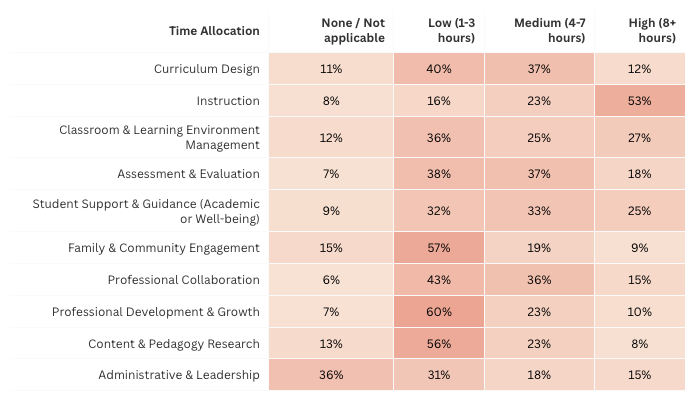
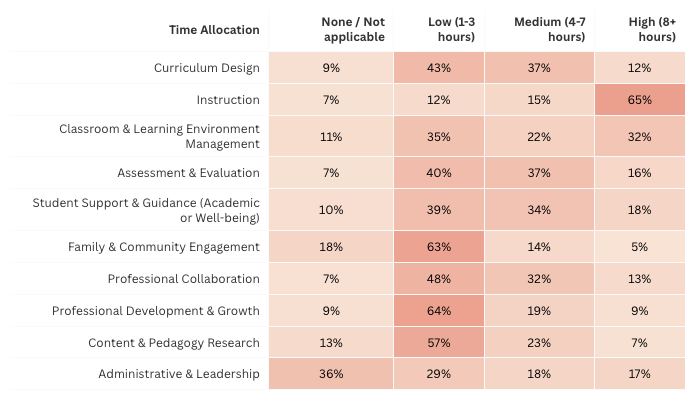
2. The most time-intensive and relational aspects of teaching remain primarily human

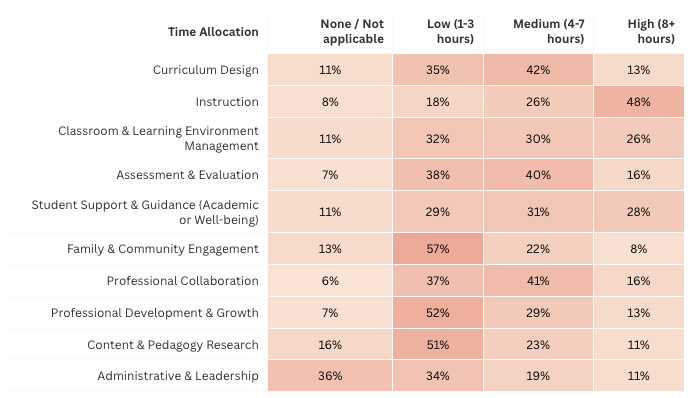
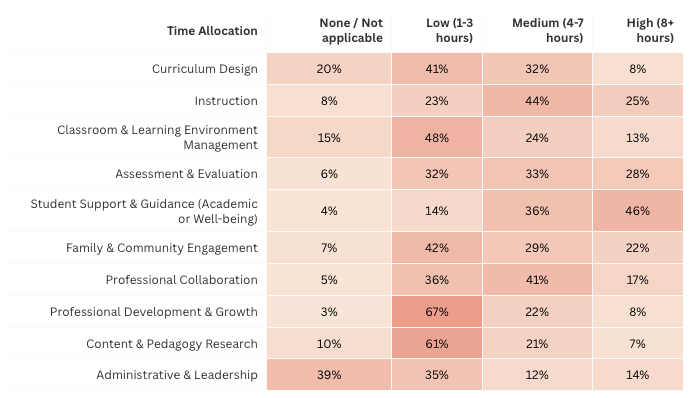
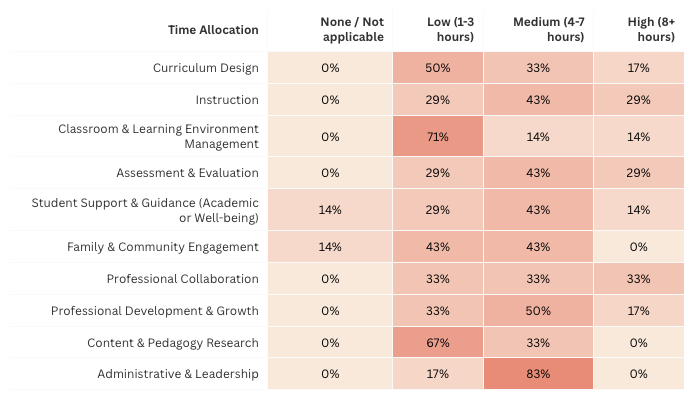
Curriculum Design and Content & Pedagogy Research rank 6th and 8th in weekly time investment but 1st and 2nd in reported AI impact. Instruction, Student Support, and Classroom Management rank 1st, 2nd, and 3rd in time intensity but 3rd, 8th, and 9th in AI impact. The responsibilities that absorb the most educator time are, with one exception, the least touched by AI.

Supporting Data

Across all ten responsibility areas, "No big impact / Not applicable" is the most common response. The relational and real-time responsibilities show the highest rates of non-impact: Family & Community Engagement (63%), Student Support (59%), and Classroom Management (55%).

Instruction is a partial exception. It ranks 1st in time intensity and 3rd in AI impact, with 56% of respondents reporting some positive effect. Its position in the data warrants closer examination in subsequent research phases.

Very few respondents select higher-order impact categories in any domain. The combined rate of "transforming my approach" and "unlocking entirely new possibilities" does not exceed 17% in any responsibility area.

Interpretation

The distribution of AI impact across the teaching role broadly follows the boundary between preparatory work and live work with students. Responsibilities that are analytical, asynchronous, and independent of student presence show the greatest AI penetration. Those that are relational and real-time show the least — with one exception. Instruction ranks high in both time intensity and AI impact, complicating a simple preparatory/live divide. Whether AI is reaching instruction through back-end preparation or through direct use with students is not resolvable from this data. Whether the overall distribution reflects a structural ceiling on AI's reach or the current stage of adoption remains an open question.

Scope note

- Question sample size: 994
- This finding does not assess instructional quality or outcomes, only reported time allocation and perceived impact.

During a typical work week, how much time do you spend on each of these responsibilities?
Click to browse data
Comparison of Time Allocation and AI Impact Across Teaching Responsibilities
Click to browse data
Future-Oriented Findings:

Educators’ Expectations and Boundaries

The following findings examine educators’ views on potential future scenarios as AI becomes more widespread in education. These scenarios capture respondents’ judgments about desirability and perceived likelihood, rather than predictions or endorsements. Together, they surface where educators see promise, where they express concern, and how they draw boundaries around the appropriate role of AI in teaching and learning systems.

3. Futures centered on automation generate more resistance and uncertainty than futures centered on role reconfiguration

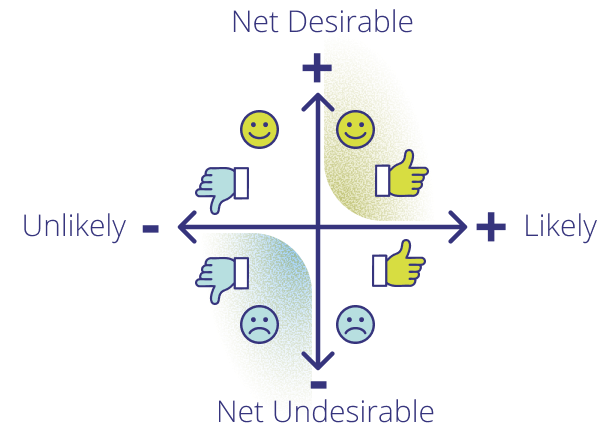
When comparing scenarios on the likelihood–net desirability chart, a consistent pattern emerges: futures that position technology as the primary driver of foundational instruction generate more resistance than futures that reorganize educator roles, learning structures, or professional growth.

Supporting Data

The scenario:
“Students will learn fundamentals and core subjects mostly through adaptive digital tools.”

  • Net Likelihood: 42%
  • Net Desirability: –19%
  • Highest concentration of undesirable responses (50%)
  • Largest share of “Likely & Undesirable” selections of any scenario

On the chart, this scenario appears as a clear outlier in the lower-right quadrant: widely viewed as plausible, yet evaluated negatively overall.

Interpretation

Resistance is not distributed evenly across AI-related futures. It concentrates most clearly around the scenario in which adaptive digital tools become the primary mechanism for delivering core subjects.

By contrast, scenarios that expand, redesign, or diversify teacher roles, or that increase authenticity and relevance of learning, receive substantially stronger support. The pattern suggests that educators differentiate between types of transformation.

Scope note

- N: 848
- These findings reflect educators’ judgments about likelihood and desirability, not explanations for why certain scenarios are evaluated differently. The data indicate patterned differences in response, but do not measure underlying motivations.

Over the next 10 years, how likely and desirable are the following future scenarios?
Click to browse data
Core subjects:
Students will learn fundamentals and core subjects mostly through adaptive digital tools.
Personalization:
All instruction will be personalized for each student using real-time student data.
Learning paths:
Students will create, co-design, or choose their own learning path to reach expected outcomes based on their interests and goals.
Skill-based assessments:
Student assessments will shift from traditional tests to portfolios of work and skills-based credentials.
Well-being & mental-health:
Teachers will serve as a primary coach for individual students' well-being and resilience.
Career navigation:
Teachers will coach students in career navigation and continuous, lifelong upskilling.
Familes & community:
Families and community partners will co-create learning experiences for students
Real-world projects:
Teachers will develop real-world learning projects for students, in partnership with outside organizations like local businesses.
Collaborative learning:
Teachers will facilitate online collaborative learning with students from around the world.
Flexible teaching:
Teachers will use flexible learning environments that adapt between in-person, hybrid, and remote models.
Learning cities:
Teachers will teach outside of the walls of the classroom, within various community facilities.
Teacher PD:
Teachers will develop their skills through personalized professional development.
Research projects:
Teachers will pursue research projects of their interest within the work day.
Team teaching:
Teachers with specific expertise will work in flexible teams to serve large groups of students together.

4. Alignment appears around a set of future-oriented teaching practices

When examining scenarios collectively, responses organize into four distinct patterns based on the relationship between perceived likelihood and desirability.

Supporting Data

Four clear clusters emerge across the scenarios:

Rejected Future (Likely but Undesirable):

  • “Students will learn fundamentals and core subjects mostly through adaptive digital tools.”
    Net Likelihood: 42%
    Net Desirability: -19%

This scenario stands alone as the only future that is widely expected yet evaluated negatively overall.

Consensus Futures (Likely and Desirable)

  • Real-world project-based learning partnerships
    Net Likelihood: 48% | Net Desirability: +73%
  • Personalized professional development
    Net Likelihood: 51% | Net Desirability: +71%
  • Portfolio- and skills-based assessment
    Net Likelihood: 34% | Net Desirability: +55%

This scenarios cluster in the upper-right quadrant, combining strong support with moderate-to-high expectations of occurrence.

Aspirational Futures (Desirable but Not Fully Expected)

  • Teacher-led research during the workday
    Net Likelihood: -3% | Net Desirability: +50%

These scenarios show positive net desirability but lower perceived likelihood.

Contested Futures (Mixed Sentiment)

  • Student-driven learning pathways
    Net Likelihood: 19% | Net Desirability: +37%
  • Flexible teaching teams
    Net Likelihood: 37% | Net Desirability: +41%
  • Career navigation and lifelong learning coaching
    Net Likelihood: 34% | Net Desirability: +40%
  • Community co-creation of learning experiences
    Net Likelihood: -1% | Net Desirability: +26%
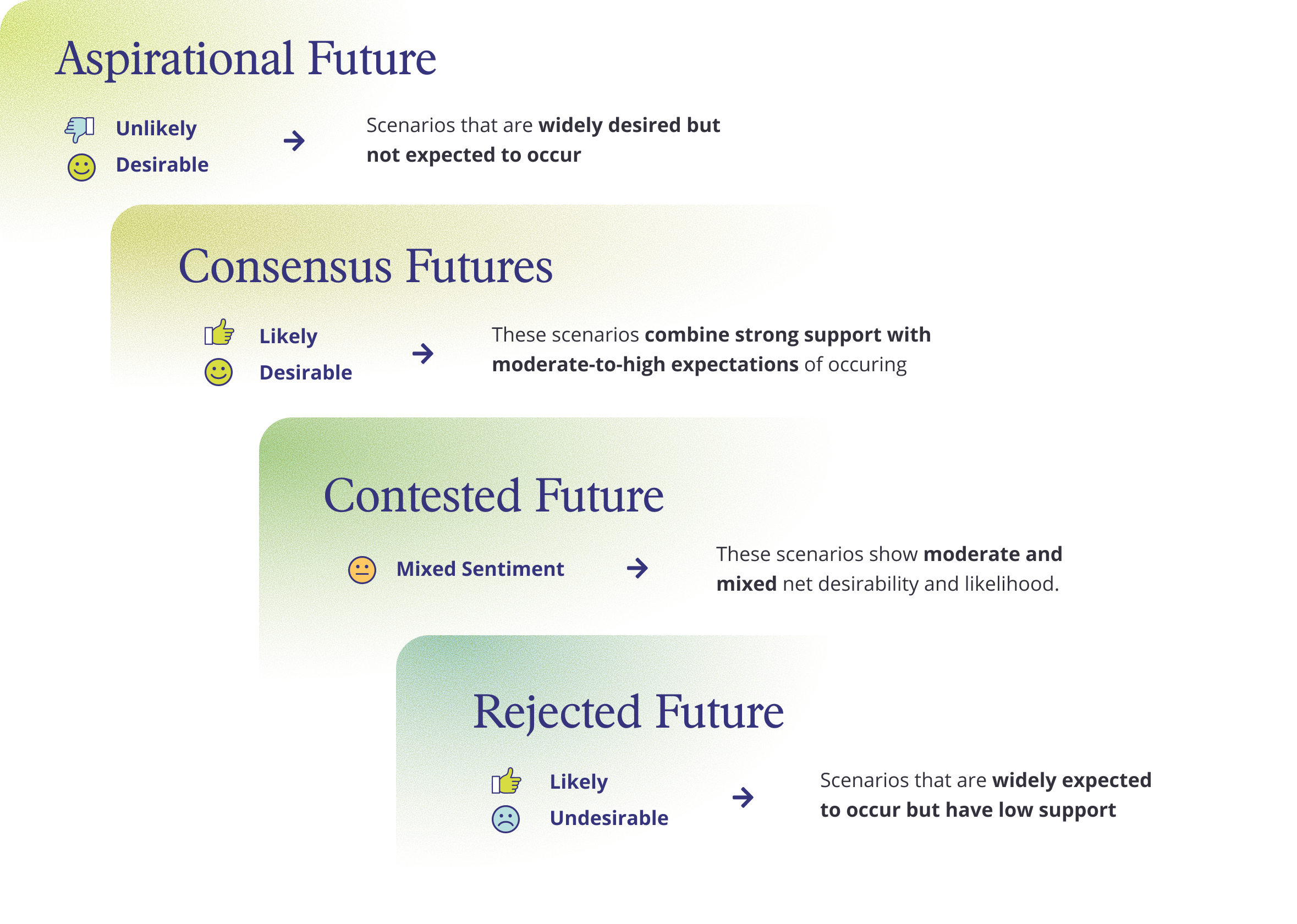
These scenarios show moderate and mixed net desirability and likelihood.

Interpretation

The relationship between desirability and likelihood is uneven across scenarios. While high desirability often aligns with higher likelihood, the inverse is not true: lower likelihood does not consistently signal strong support that is unmet.

The concentration of these mixed-response scenarios may suggest that several proposed futures are not yet clearly defined or fully formed in respondents’ expectations, resulting in more tentative or varied judgments of their desirability.

Scope note

- N: 848
- These findings reflect educators’ judgments about likelihood and desirability, not explanations for why certain scenarios are evaluated differently. The data indicate patterned differences in response, but do not measure underlying motivations.

5. The strongest AI-related concerns center on trust, integrity, and student protection

The strongest concerns relate to academic integrity, misinformation, bias, and student privacy, while fears about job displacement or cost are less prominent. These concerns reflect a focus on safeguarding learners and maintaining trust, rather than resistance to AI adoption.

Supporting Data

The highest concern levels are reported for:

  • Academic integrity and cheating
  • Misinformation and bias
  • Student privacy, safety, and data protection

Concerns related to job security and cost register at comparatively lower levels.

Interpretation

Read alongside future-state responses, these concerns align closely with resistance to automation-heavy instructional models. Educators’ boundaries appear grounded in trust, protection, and responsibility to learners, and not opposition to AI adoption or anxiety about replacement.

Scope note

- N: 818
- This finding captures perceived risks, not measured incidence or effectiveness of mitigation strategies.

Concerns About the Use of Generative AI in Education
Click to browse data

6. Institutional context shapes how educators are experiencing AI today and imagining the future of the profession

Despite similar reported access to AI and comparable time spent across responsibilities, institution type appears to matter in how educators interpret AI-related change. The strongest differences do not emerge evenly across the survey, but are most visible in how educators evaluate future scenarios and the extent to which they describe AI as creating friction in their current work.

Supporting Data

Across future-state scenarios, private school respondents were consistently less likely than public and public charter respondents to view many AI-enabled shifts as desirable, particularly those involving:

  • Flexible learning environments
  • Student-driven learning pathways
  • Family and community co-creation
  • AI-mediated personalization
  • Expanded educator roles such as career navigation and coaching

This pattern was also reflected in present-state work. Across multiple responsibilities, private educators were more likely to report hindrance caused by AI.

For example:

Classroom & Learning Environment Management

Hindering my work:
Private: 13.24%
Public: 9.69%
Public Charter: 2.70%

Assessment & Evaluation

Hindering my work:
Private: 14.87%
Public: 9.00%
Public Charter: 6.08%

Interpretation

With similar reported access to AI and comparable time allocation across responsibilities, the sharpest differences between private, public, and public charter educators emerge in how they judge the desirability of future scenarios and whether AI is experienced as helpful or as a source of friction in their current work.

Possible factors shaping these differences may include varying levels of openness to changing traditional teaching models, differences in institutional flexibility, the degree of alignment between AI and a school’s instructional model, the quality of present-day implementation experiences, organizational support for experimentation, and differing perceptions of the risks associated with AI moving closer to core teaching work.

Scope note

- N varies by item
- These findings reflect differences in educator responses by institution type, not causal explanations for why those differences exist. The data indicate patterned variation across sectors, but do not identify the specific institutional, cultural, operational, or policy conditions driving those differences.

7. The core of teaching is defined by relational, situational, and ethically grounded work

When asked to describe the most human part of their work as teachers - the part that would still matter even in a world where AI might perform many other functions - respondents overwhelmingly emphasized relationships, connection, emotional attunement, and real-time responsiveness. These themes recur not as abstract ideals, but through repeated, concrete language describing how teachers notice, respond to, and care for students as whole people. Recurring words and phrases across open-ended responses were examined and grouped into thematic role clusters.

What do you consider the most human part of your work as a teacher  —  the part that would still matter most, even in a world where AI might do almost everything else?

Personal relationships are going to remain essential and important beyond everything else.

Relationship Anchor

Engaging with students, supporting them in their learning, learning who they are and what they struggle with, and guiding them toward a greater understanding of the world and their place in it.

Emotional & Developmental Guide
See all 790 responses

Talking to and sharing your time with students is the most human part of teaching. However, a world in which AI does most everything a teacher or anyone else needs to do is also a world in which student outcomes no longer matter since they won't be needed anymore in the workplace in future rules.

Life Navigator

My ability to interact with the students and guide them towards goals that they are most committed. Providing them a safe environment to discuss both the benefits and potential, observed dangers of AI, the developers, and the impact these tools may have on their own future.

Cognitive Coach

Personal relationships are going to remain essential and important beyond everything else.

Relationship Anchor

Talking to and sharing your time with students is the most human part of teaching. However, a world in which AI does most everything a teacher or anyone else needs to do is also a world in which student outcomes no longer matter since they won't be needed anymore in the workplace in future rules.

Life Navigator

Engaging with students, supporting them in their learning, learning who they are and what they struggle with, and guiding them toward a greater understanding of the world and their place in it.

Emotional & Developmental Guide
Cognitive Coach

Personal relationships are going to remain essential and important beyond everything else.

See all 790 responses

Conclusion: What This Moment Reveals About the Future of Teaching

This survey captures a profession in the early stages of renegotiating its relationship with artificial intelligence. Educators are neither rejecting AI nor experiencing wholesale transformation. AI is being used selectively, concentrated in preparatory and analytical work. The relational and real-time responsibilities at the center of the teaching role remain largely unchanged, though instruction shows notable AI impact whose source — preparation or direct student-facing use — is not yet clear.

Looking ahead, educators signal openness to innovation paired with clear boundaries. They support futures that expand human judgment, relevance, and professional agency, and resist models that automate the instructional core. These findings suggest that the central challenge is how systems choose to evolve around the adoption of AI in education. The opportunity lies in redesigning roles, structures, and supports so technology strengthens the human work of teaching rather than displacing it.

This survey does not predict the future of teaching. It clarifies where change is most likely to earn professional legitimacy and public trust. As such, it provides a foundation for the next phases of the Portrait of a Teacher in the Age of AI project: mapping educator roles that reflect real work, identifying competencies grounded in judgment and care, and supporting educators, leaders, funders, and builders in designing systems capable of meaningful transformation.

We’re left with an open question: Will AI enable a redesign of education systems that expand human judgment and close the gaps the current model continues to reproduce, or will it preserve the status quo?

Conclusion:

What This Moment Reveals About the Future of Teaching

This survey captures a profession in the early stages of renegotiating its relationship with artificial intelligence. Educators are neither rejecting AI nor experiencing wholesale transformation. AI is being used selectively, concentrated in preparatory and analytical work. The relational and real-time responsibilities at the center of the teaching role remain largely unchanged, though instruction shows notable AI impact whose source — preparation or direct student-facing use — is not yet clear.

Looking ahead, educators signal openness to innovation paired with clear boundaries. They support futures that expand human judgment, relevance, and professional agency, and resist models that automate the instructional core. These findings suggest that the central challenge is how systems choose to evolve around the adoption of AI in education. The opportunity lies in redesigning roles, structures, and supports so technology strengthens the human work of teaching rather than displacing it.

This survey does not predict the future of teaching. It clarifies where change is most likely to earn professional legitimacy and public trust. As such, it provides a foundation for the next phases of the Portrait of a Teacher in the Age of AI project: mapping educator roles that reflect real work, identifying competencies grounded in judgment and care, and supporting educators, leaders, funders, and builders in designing systems capable of meaningful transformation.

We’re left with an open question: Will AI enable a redesign of education systems that expand human judgment and close the gaps the current model continues to reproduce, or will it preserve the status quo?

What do you consider the most human part of your work as a teacher  —  the part that would still matter most, even in a world where AI might do almost everything else?
Builds trust, connection, and belonging across students, families, and communities
"The interactions with people engaged in in-person learning offline."
"interaction with students to get to know their approach to learning."
"Caring"
"Working eye to eye and shoulder to shoulder with the children and my colleagues."
"Interaction with students on a human level, obviously."
"I think children learn primary through human interaction, which AI categorically cannot replace."
"Personal interactions with students without technological filter"
"Everything I do it human. AI is not a replacement for human interaction."
"Noticing and naming what is happening with students"
"Making sure students know they matter"
"Personal interactions with students and families. I work with students from admissions to graduation and know their stories and successes."
"Connecting with kids and families. Teachers don't teach. They give students instructional materials and hope they learn enough to make the government happy with their test scores, which is to say that my job is only to make admin look good. The profession is a total joke and teachers could and should be replaced with computer aided technologies that helps kids grow cognitive thinking skills, empathy, and a more equitable worldview. Instead, we just make standardized robots willing to comply to the political demands of our culture. It sucks. 30 years in the profession and nothing has changed except we comply because we actually care about kids."
"I would not work in a situation where AI did much in relationship to the teaching I do. If it does, I will seek jobs where it is not allowed or is highly restricted. Teaching kids - face to face/ synchronous is the most human part. Reading the student to enable the teacher to present materials in different ways and to find a way that allows the student to best access problem solving and learning skills and content based on their own tableau of neural and social strengths and differences is vital for a teacher to assist students. Overuse of any AI generates individuals who can guide/provide inputs to a system but is extremely negative to survival and competing in a challenging and quickly changing world outside of academia or city skyscrapers for those same individuals. For example: use of AI to answer test or homework questions, on one level, gets students good grades - but for ACT testing, State testing, etc., it leaves them high and dry since there is no mommy AI to answer everything for them reducing their chances of scoring well. On a somewhat deeper level, it will create an individual who can do a number of (mostly computer assisted of course) things but don't know much, certainly not content necessary to allow them to partake meaningfully in their government. On another level, oops, cell phone is out - no GPS! No immediate answers to questions. No Siri or Alexa to entertain them. Unhappy/weakening consequences become statistically more immanent. Finally, if they do survive, the ability to become programmed in a multitude of ways, slowly but surely, by those completely uninterested in their welfare in and of themselves as sentient persons, from bread and circuses level dumbing down entertainment, to having no real ability, often to understand, contribute to or care about the propaganda and memetic wars waging all around them, (which have existed from early history to today's governments, corporations and any other interest group who wish to control someone for some reason). EVERY part of teaching a child should be controlled or managed by a/a set of human and, insofar as is possible, a teacher or set of teachers able to teach in an unbiased fashion. Making work easier is not always positive or desirable. It can be extremely negative and debilitating to learners young and old. AI will, likely, act as a crutch to those who started out strong, making them weaker. That would be a horrible consequence for our children and grandchildren."
"Interactions with students at an emotional level. AI can try to replicate this, but humans are best at it. AI certainly can give 24/7 academic support and even basic emotional support, but when it comes to deep rapport building- humans will still be necessary, always!"
"Providing SEL and support for students and families."
"Helping a child feel seen and understood"
"Calling and supporting students in an effort to help them succeed in Education"
"Working directly with my students. My day-to-day interactions with students requires dealing with me as people, complex people with multiple needs and emotions and baggage. Students also need support working with each other. Teamwork, with or without AI support, is still important."
"The interactions I have with my students to make them feel welcomed. Academics is only part of being a teacher."
"Education is not about ticking boxes, but about discovering passions and getting our students to realistic outcomes. These goals do not feel in line with what AI or LLMs can, or should, do."
"the safety and mental and emotional wellbeing of individual students."
"I understand that the teacher will never be replaced by artificial intelligence, since students need the human factor and the emotional aspect of learning to be effective. My biggest concern is that it automates education too much, and then the essence of what education is lost"
"Yes, i use ai to support those parts of my teaching. This provides me with the ability to use ai to just support my god teaching practices."
"Supporting the student."
"The most human part of my job is managing student emotions, conflicts, behaviors that AI couldn't do. AI could not manage 25 students at a time."
"Engaging with students, supporting them in their learning, learning who they are and what they struggle with, and guiding them toward a greater understanding of the world and their place in it."
"I teach theatre. I work with human beings--in the moment--helping them learn how to navigate feel and expression. AI cannot replace that. It can enhance or augment HOW that happens, but my work requires fully human engagement from the student."
"Even in a competitive high school setting, I teach kids more than I teach content. AI can offer content, but I am not convinced that I support how AI serves them as developing, whole people."
"The months that I spend getting to know each of my students, as learners and also as emotional beings"
"The emotional health/ needs of young as well as HS students."
"Interacting and helping students with academic problems and emotional support."
"Speaking with students, understanding their real-time emotions, and their sense of challenge or accomplishment."
"Knowing my students well, giving the human support that they need and to be able to answer their questions."
"Helping students communicate effectively and think critically, building their human intelligence - a combination of cognitive, emotional, physical, social, and moral intellect -"
"The most human part of my work is being able to answer / engage in conversations with students. For instance, students may ask a follow up question to a given concept, and the back and forth and exploration into 'what if' is something that I don't think can be replicated by AI. Teachers / educators can prompt critical thinking and exploration in a way that AI cannot do. Currently, AI will just provide a response to any question and then ask it's own follow-up, so students do not have the opportunity to engage in critical thinking / problem solving. In addition, social-emotional support is also the most human part of my work that absolutely cannot be replicated."
"Teaching students how to use human reason, which AI could never do. It will always lack in context and specificity--only talented teachers can pull genuine thoughts and feelings out of a student, and help them learn how to shape those ideas."
"Human intervention and personal attention is absolutely vital to learning, and I know this from significant experience. I am a virtual class coordinator whose days are spent supporting and coaching kids taking online courses across many different subjects. When kids struggle, it's my personal, on-site interventions that often help students solve problems and move forward. When content issues are more than I can handle, a "meeting" with their virtual teachers in video conference or by phone is often the key to ultimate success. I also see that students taking corresponding courses in-person here in our tiny, rural school tend to learn more."
"The most human part of my work as a teacher are being able to respond to students thoughts and emotions in real time with thoughtful insights from my own knowledge and experiences."
"Authenticity, emotional presence, divinity in humanness witnessing divinity in another human. storytelling, contextualizing through real actual memories, experiences, nuanced information. Human to human, imperfect yet sacred."
"Social Emotional Learning, Hands-On experiential learning outside the classroom."
"The most human part of my work as a teacher is helping my students step out of their comfort zones to develop confidence in their academic skills."
"Managing a student's anxiety and emotions prior to their learning so they can maximize their potential."
"Supporting students emotionally, caring for them as individuals, helping them build confidence in who they are as people in the world, and seeing, knowing, and loving them."
"Helping to build confidence in kids, explain concepts and feedback multiple ways, bring emotional warrh and motivation with with high expectations and real world relevancy"
"Teaching students how to collaborate and learn to be interdependent. They need to learn how to be kind to each other and work together through struggle. They need to be believed in and feel confident. That is my main goal as a teacher, they will learn, but the citizenship of being a human and a student is more important."
"facilitating nuanced discussions and designing environments where students feel safe, belonging, seen, and empowered to learn collectively with peers in order to solve real life problems."
"Getting to know my students and how they learn best, including in consideration of their mental health and their social emotional needs, and designing their instruction accordingly."
"Empowering students to feel learning and life has meaning when AI might render it meaningless."
"Emotions and empathy"
"Emotional and creative growth, empathy, and fact-checking"
"So much of what we do as educators is uniquely human. Noticing when a student is having a rough day and offering support. Offering encouragement when the topics get tough. Pushing students to think deeper about topics in class discussions. Sitting with them as they struggle through a problem set because they don't have the ability yet to work independently. On our field trips - showing them the wonder of the natural surroundings or showing them how to catch pond invertebrates. In our science classroom - how to navigate complex data collection with a team. How to have a respectful discussion while at the same time disagreeing passionately."
"Supporting students with personalized language and emotion through honest feedback and encouragement."
"The most human part of my work as a teacher personal attention, support and encouragement, especially in the early childhood ages."
"Teachers have the responsibility of educating each individual. In addition to this, educators have to check in on every student every day. In many cases the student is struggling with an internal conflict and needs this personal interaction to ease their worry or motivate them to stay diligent. There are some cases where the slightest change in a child could be a serious indicator of something more where intervention is needed. The phrase "it takes a village" highlights the importance of a community. Educators not only serve as academic facilitators but also as the first line of support, they play in integral part in the "village"."
"Pushing kids to go deeper in their ideas/analyses of (in my case) literature, facilitating discussion and debate, helping kids feel good about themselves, and not to sweat the small stuff."
"Social responsiveness, the ability to gauge a student's feeling state and encourage/push them to achieve what is reasonable for them today, and to back off before they get too frustrated, adapting my strategy to the individual student in a very intuitive and hard to quantify in data sort of way."
"Being able to socially, emotionally and academically support my students."
"Social Emotional Interactions"
"Seeing and engaging with the students physically, to support their life skills, and social-emotional well-being."
"Classroom management with daily social emotional lessons"
"My daily interperson interactions with my students would not be possible if we leaned into AI as an education tool. Since COVID, my school has tried to pull away from technology use as much as possible to descrease student screentime and support interpersonal communication skills. Shifting to more digitized learning would be a catastrophe."
"Helping young students with social and emotional skills (emotional regulation, self-awareness, interpersonal interactions) that allow them to thrive academically."
"Human contact, support and socialization skills"
"Emotional and social intelligence"
"Sitting and talking with students. Giving support for academics and social/family issues. Demonstrating how to be focused on one thing, or how to be bored and waste a little time, moments that seem to be disappearing and that require imagination and self-reliance are rare."
"The most human part of teaching is being a teacher. In other words, understanding that every has a lot that they bring to the table and learns in, some slightly, others not, different ways. There is no scenario where an AI will be able to overcome the breadth of skills needed to address the needs of students."
"AI can give information, but it can't reach students. It can't listen when students talk about their hopes, fears, and struggles."
"Being a human listening to the hearts of other humans, and helping students find their own original voice as writers and speakers and use that voice effectively. Also, just to say: if AI does everything else, I will quit teaching. I'm not working as a teacher to enable a machine to talk to machines and to turn my students into cogs."
"Feedback in the moment - body language of learning - sense of community, being seen and thus being known as a student."
"The opportunity to talk and listen to students feelings, worries, concerns, goals and provide a safe place for them. Human contact"
"The ability to read and hear the human tones and emotions in their answers and responses, and that intuition, in a sense, to understand that even when students or parents say things are good, but you can see they aren't, and you have to push more to understand. Working with students with trauma and complex backgrounds or rough homes, they don't always just fit the natural or expected pattern, and we as educators have to use that intuition based on what we know of them and reading those human interactions that computers don't see. This happens so much more in education than people realize, and I think that is a concern I have, which is to support that."
"Creating an ethos and work ethic in the classroom. Anyone can look up anything on the internet, that much has been true for decades. AI has just made it easier, but can it motivate a student to produce authentic work because they're proud of it? Can it help them look competent in a job interview or simple conversation without reading off a screen? Can it turn them into productive, self-reliant, and conscientious humans? That's where we come in. At its core, AI will never be human, thus it can't teach humans to learn resilience from failure, or to experience and savor the joy of hard work come to fruition, or the tenacity of pursuing something because its your passion. The hysteria of generative AI in the classroom is reminiscent of the same hysteria when the internet started to become more popular, when I was in high school. It's a tool with amazing capabilities, but at the end of the day it's just a tool. I don't credit the internet with any success I've had, I thank my teachers for making the lessons I've learned memorable and instilling the pride I have in the work to which I put my name."
"Classroom instruction and shaping of the experiential way in which students interact with content. Fostering and encouraging student potential and helping students to avoid self-discouragement and self-destructive behavior."
"I don't view any part of my job as better if automated by AI. I believe my role as a teacher as a whole is human, and you cannot strip down teaching into some narrow core part that will be better without "all the rest". This is a leading question."
"Modeling and teaching resilience, creativity, confidence, interpersonal skills, teamship skills, kindness, and empathy"
"Encouraging and getting my students to believe in themselves and in their ability to learn. Middle school is a time of major self doubt and until students can conquer that challenge they will struggle academically and socially."
"The in person interaction and communication with the students. Being able to give them hands on skills that they need to be successful in the real world. None of that can be done over a computer."
"Helping students learn to express themselves and their own ideas, cogently and with integrity, based on actual learning. Presently, students are just using AI to cheat"
"Getting to know the student's strengths, interests, and values."
"I think helping student to become there best selves including, but not limited to, teaching empathy, engagement, interpersonal skills, wellness, communication, critical thinking and literacies such as media, online, AI, etc, is all of our responsibilities and can't be replaced."
"Teaching the "soft skills" of empathy, compassion, exploring purpose, as well as teaching problem-solving skills."
"Encouraging the heart of the student, especially when it comes to exploring who they can become. Human students are still becoming human adults, and they need human role models and sources of encouragement on their developmental journey."
"personal interactions with students about their lives, their families, their goals, etc. and the encouragement that comes from a human being cheering you on for your successes and helping you move forward when you are struggling"
"Encouraging the personal excitement of learning, how to be a good human and think of others, how to consider the individual's impact on the world and inspire positive changes."
"Dealing with our students as humans not machines to be programmed with specified content. Helping students navigate the individualized issues that might derail educational progress. Being a cheerleader and life coach to encourage internal desire for growth and help navigate how to get where they'd like to go."
"Encouragement to break out of internalized messages."
"The ability to reach out and give a physical human touch of encouragement and reassurance (high-five, hug, etc.). Teachers can still curate some knowledge, but maybe we'd all become therapists or coaches instead."
"Being a sounding board for students that just need to talk out a problem. Giving encouragement and saying, "It's Ok to Fail.""
"Making positive and supportive relationships with students, teachers, and stakeholders. Mental and emotional support is something that should continue to be done by humans."
"Connections with students, making them feel seen and valued"
"Building relationships with students that safe and supportive for young people."
"Building relationship skills, a friendly helpful voice, personal knowledge and experience, feeling of student/teacher collaboration."
"Providing a human and personalized approach to a student's growth, connecting with them and motivating them so they don't feel like just another drone attached to a computer. Making creative connections, bringing a subject to life, creating engaging experiences that go beyond just staring at a screen. Facilitating conversations, helping students connect and share their opinions, not through a screen."
"A teacher is far more than a tool to prepare and deliver lessons. A teacher creates an environment where students feel safe, supported, and connected. Building meaningful relationships through consistent, face-to-face interactions allows students to thrive, especially those who struggle. When teachers take the time to truly know their students, both inside and outside the classroom, they foster trust, motivation, and growth. For this reason, I do not believe that a teacher can ever be fully replaced by AI or achieve the same depth of human connection and learning outcomes."
"The most human part of my work as a teacher is the relationship-building and trust that happens with my students. AI can generate lessons, assess essays, or provide personalized practice, but it cannot replicate the way I see, know, and care for my students as whole people: their stories, cultures, struggles, and hopes. Even in a world where AI could handle nearly every technical task of teaching, what would still matter most is my ability to inspire confidence, create belonging, and affirm identity for emergent bilingual students. Many of my students carry the weight of navigating a new language, a new country, or a school system that doesn't always see them. What keeps them showing up, trying, and believing they can succeed is not just the lesson: it's the way I connect with them, adapt when they're frustrated, celebrate their growth, and remind them they are capable of more than they imagined. AI can provide scaffolds, but it cannot offer human presence, empathy, and love (the things that make learning feel worth it). That's the part of teaching that will always be irreplaceable."
"In a world where AI "might do almost everything," the most human part of my work -- connecting meaningfully with students, helping them find their distinct voices as speakers and writers, and observing the absolute joy they feel after having created something unique, distinct, and beautiful -- will likely die."
"I answered this survey based on my school, which is an independent private school whose mission focuses on connection and interpersonal relationships to help students develop into adults. In other schools I've worked at, this wasn't true. But here I feel that reflection about the person you want to be, your impact on community (both local and global), and defining what meaningful success looks like for you individually instead of just grades / trophies / money makes this job a very human endeavor."
"I think that the most important human part of the work that I do as an educator comes from the relationships that I form with my students. Despite the accessibility of AI resources, many of my students would much rather hear feedback from me about their work or have a conversation with me about steps moving forward. Relationships are a big part of teaching, and I feel like AI cannot be a subsitute for those connections. Additionally, I am a language teacher, and so much of language isn't just right or wrong, and there is often a lot of "grey area" where many different ways of saying something can be acceptable based on context. I feel as a human, I am more capable of analyzing those situations better and helping to guide students toward effective real-world conversations in their language of study."
"Knowing each student and understanding what they need to succeed as a student & building relationships with them so they know they are respected and supported."
"Human connection, building empathy and compassion, nurturing the social/emotional, building character and resilience, promoting community"
"Student-teacher interaction, interpersonal relationships, and the importance of empathy as an integral part of understanding and creating an environment that simply feels."
"For me, what matters most in teaching is not the transfer of information, but the human connection that nurtures growth, belonging and purpose. At its core, it is the relationship between teacher and student - the teacher who models values, guides learning and creates a space where students feel seen, heard, valued and safe. That connection is the most human part of teaching, the one we should preserve."
"Relationship-building - learning to understand and work well with many different kinds of people - empathy building and direct real world emotional and social support"
"interpersonal connection - seeing each other's humanity - serving as a model for young people (breaking stereotypes) - curiosity - learning with discomfort & from mistakes - lifting up values such as empathy, selflessness, generosity, gratitude, encouragement, celebration, cooperation, & partnership"
"Assessing social-emotional needs and how they affect a student's learning is the most important part of my work as an educator. For years, building relationships has been the cornerstone of education. You can't have a real relationship with AI. So much research supports the dire importance of face-to-face human connection!"
"Social emotional aspects of teaching, connection and relationship building, responding to the unpredictable,"
"Some students have little support at home and school is the only place they find human connection and a reliable adult in their life. We teach social-emotional learning and connection (whether intentionally or not) and that is not something that AI can replace."
"Connections with humans! Teachers play a huge role in connecting with the social emotional needs of students. This includes food, clothing family relationships (or lack there of), how students socialize with each other and connect as friends and peers. The social piece you can never change for AI. Really getting to know the students and who they are individually can really impact how a student learns and if they thrive in the classroom."
"The most human part of my work as a teacher is the relationships I build with students and the example I set for them. Teaching is not just about delivering content but about encouraging, challenging, and supporting young people as they grow. Students need someone who notices their struggles, celebrates their progress, and models qualities like resilience, fairness, and curiosity. AI may be able to generate answers or deliver lessons, but it cannot offer trust, guidance, or the moral formation that comes from human connection. What matters most is helping students not only learn how to solve problems, but also how to think critically, find meaning in their studies, and imagine the kind of person they want to become. That human formation is what teaching is truly about, and no technology can replace it."
"The most human part of my work as a teacher—the part that would still matter even if AI took over everything else—is the way I connect with students in real time. Not just academically, but personally. It’s the moment I notice a student’s silence and ask, “Are you okay?” Or when I tweak a bilingual flyer so it feels more welcoming to a student who’s nervous about signing up. It’s the way I use humor, memes, or even a bug crawling across the windowsill to spark curiosity and conversation. AI can generate resources, translate text, even simulate feedback. But it can’t feel the room. It can’t sense when a student needs encouragement, or when a joke will break the tension, or when a spontaneous story will make the lesson stick. That’s where I come in. I teach language, yes—but I also teach confidence, empathy, and belonging. I help students see themselves as capable communicators, not just in Spanish, but in life. That’s the part no machine can replicate. That’s the part I’ll never give up."
"The most human part of my work as a teacher is the moment of connection, that instant when a student feels seen, understood, and capable. It isn't found in the lesson plans or the technology, it's in the quiet moments of empathy and trust. When a student's eyes light up with understanding, or when laughter breaks the tension of learning, I'm reminded that education is deeply emotional work. AI might one day explain every concept perfectly, but it will never replace the warmth of patience, the encouragement that builds confidence, or the shared joy of discovery. Teaching is not just the transfer of knowledge, it's the nurturing of spirit. Even in a future shaped by technology, what will matter most is our ability to listen, to care, and to awaken humanity in one another."
"The humanness of discerning data to make inferences would disappear. When you visit the doctor, do you trust the ones whose face remains in a computer, checking boxes to allow AI to determine what is wrong with you? Or do you like a doctor who is questioning and data gathering to determine your diagnosis? The part I enjoy most is listening to students share their ideas and come to consensus when problem solving. Human interaction and collaboration need to be modeled and practiced to be effective. Who will encourage our youth to dream, have hope, and plan for a future they can achieve. I am concerned our innovative thinking process will deteriorate and we will become a society of nonthinkers."
"In a world where AI is evolving and becoming more prevalent, teachers will still serve as the empathetic and critical thinking partner with students and school communities."
"I would not work in a situation where AI did much in relationship to the teaching I do. If it does, I will seek jobs where it is not allowed or is highly restricted. Teaching kids - face to face/ synchronous is the most human part. Reading the student to enable the teacher to present materials in different ways and to find a way that allows the student to best access problem solving and learning skills and content based on their own tableau of neural and social strengths and differences is vital for a teacher to assist students. Overuse of any AI generates individuals who can guide/provide inputs to a system but is extremely negative to survival and competing in a challenging and quickly changing world outside of academia or city skyscrapers for those same individuals. For example: use of AI to answer test or homework questions, on one level, gets students good grades - but for ACT testing, State testing, etc., it leaves them high and dry since there is no mommy AI to answer everything for them reducing their chances of scoring well. On a somewhat deeper level, it will create an individual who can do a number of (mostly computer assisted of course) things but don't know much, certainly not content necessary to allow them to partake meaningfully in their government. On another level, oops, cell phone is out - no GPS! No immediate answers to questions. No Siri or Alexa to entertain them. Unhappy/weakening consequences become statistically more immanent. Finally, if they do survive, the ability to become programmed in a multitude of ways, slowly but surely, by those completely uninterested in their welfare in and of themselves as sentient persons, from bread and circuses level dumbing down entertainment, to having no real ability, often to understand, contribute to or care about the propaganda and memetic wars waging all around them, (which have existed from early history to today's governments, corporations and any other interest group who wish to control someone for some reason). EVERY part of teaching a child should be controlled or managed by a/a set of human and, insofar as is possible, a teacher or set of teachers able to teach in an unbiased fashion. Making work easier is not always positive or desirable. It can be extremely negative and debilitating to learners young and old. AI will, likely, act as a crutch to those who started out strong, making them weaker. That would be a horrible consequence for our children and grandchildren."
"helping students interpret, analyze and synthesize information received and applying that to a variety of situations"
"Helping them navigate the nuance and complexity of thinking and understanding. Teaching them to think, question, and discern."
"Human interaction is critical to the success of any student. You cannot deviate from the human factor as that will be a critical tool in improving student outcomes."
"Human interaction is critical in my role as a teacher."
"Prompt engineering is crucial, as well as ensuring that what is generated is looked at through a critical lens. If it will impact our job security, then please help us to learn the skills necessary to stay current and relevant. I am not sure resonance can be reached through AI - in the way that resonance can be reached in the presence (even virtually) with another being - doesn't have to be human."
"Providing opportunities for collaboration, guiding critical thinking, fostering individual creativity."
"Guiding questions and seeing students as a whole individual."
"Teaching critical thinking"
"Helping students develop their unique voices as writers and critical thinkers"
"Teaching students critical thinking skills and compassion for others."
"The question answers itself. Being human."
"Knowing my students well, giving the human support that they need and to be able to answer their questions."
"Helping students communicate effectively and think critically, building their human intelligence - a combination of cognitive, emotional, physical, social, and moral intellect -"
"The most human part of my work is being able to answer / engage in conversations with students. For instance, students may ask a follow up question to a given concept, and the back and forth and exploration into 'what if' is something that I don't think can be replicated by AI. Teachers / educators can prompt critical thinking and exploration in a way that AI cannot do. Currently, AI will just provide a response to any question and then ask it's own follow-up, so students do not have the opportunity to engage in critical thinking / problem solving. In addition, social-emotional support is also the most human part of my work that absolutely cannot be replicated."
"Every part of my job is human and essential. Developing mechanical skills, building age appropriate critical thinking and cognitive development, improving language acquisition and comprehension, and guiding creativity. Learning is a relational experience."
"Coaching the students on a personal level, relating to them as humans with various experiences. The ability to think critically."
"There are questions that come from students during a lesson that AI cannot always explain taking into account the whole student. Real world examples that draw upon my personal knowledge and experience cannot be generated by AI-at least I hope not."
"The most human part of teaching is being a teacher. In other words, understanding that every has a lot that they bring to the table and learns in, some slightly, others not, different ways. There is no scenario where an AI will be able to overcome the breadth of skills needed to address the needs of students."
"The most human part of my work as a teacher, even in an Ai world, is evaluating the content generated by Ai. For example, we still need to teach people to read critically, to question critically, and respond and think and build off of what we are using Ai for. Ai is a partner, not a substitute for our own thoughts."
"Personal interaction with students. In-person encouragement, tutoring, field trips, etc. Students also need personalized learning. As a social studies teacher, I make sure that objectives are relateable and topic of conversation so that students feel personally involved or sparks an interest. Straight up lecture or reading won't do this. Facilitated debates and socratic discussion are imperative for critical thinking and development that should be led by a teacher and not a bot."
"My ability to interact with the students and guide them towards goals that they are most committed. Providing them a safe environment to discuss both the benefits and potential, observed dangers of AI, the developers, and the impact these tools may have on their own future."
"Creating an ethos and work ethic in the classroom. Anyone can look up anything on the internet, that much has been true for decades. AI has just made it easier, but can it motivate a student to produce authentic work because they're proud of it? Can it help them look competent in a job interview or simple conversation without reading off a screen? Can it turn them into productive, self-reliant, and conscientious humans? That's where we come in. At its core, AI will never be human, thus it can't teach humans to learn resilience from failure, or to experience and savor the joy of hard work come to fruition, or the tenacity of pursuing something because its your passion. The hysteria of generative AI in the classroom is reminiscent of the same hysteria when the internet started to become more popular, when I was in high school. It's a tool with amazing capabilities, but at the end of the day it's just a tool. I don't credit the internet with any success I've had, I thank my teachers for making the lessons I've learned memorable and instilling the pride I have in the work to which I put my name."
"Assistive technology has absolutely transformed lives for people with disabilities: screen readers, speech-to-text tools, mobility aids, and more have opened doors that were once closed. But you're right to point out that when these tools are used without intention or discipline, they can sometimes become crutches rather than bridges. But here's the nuance: the issue isn't the tech itself -it's how it's used. A person with a strong will to learn can use assistive tools to accelerate their growth. Someone without that drive might use the same tools to avoid challenges. So maybe the real question is: how do we design and implement technology in ways that encourage learning, not replace it?"
"The most human part of my work as a teacher is teaching students how to access & experience the deep, interesting, and illuminating ideas in works of Literature, and teaching them to think critically about the world using these texts, and teaching them to express themselves. I do not believe AI can accomplish ANY of these goals."
"Thinking, planning, responding."
"Helping students/people think. Think about their struggles, think about their strengths, think how to leverage their resources, think about their future, think about themselves, think about others. Then, they can plug their thoughts in to AI to get action plans or new ideas. But they have to start with their own thoughts..."
"Helping students learn to express themselves and their own ideas, cogently and with integrity, based on actual learning. Presently, students are just using AI to cheat"
"Coaching students through their own opportunities for independent critical thinking. As a teacher I know when to provide assistance, when to back away, and when to remove the training wheels entirely regarding student's learning opportunities and chances to develop content knowledge, work ethic, and constructive life skills. AI has not yet mastered the ability to detect, evaluate, and execute that critical thinking step on its own."
"Teaching students how to think critically and with empathy and integrity"
"Teaching critical, ethical, and independent thinking skills -- Recognizing how language shapes how we think, how it gets used by humans to move or manipulate, how it can make change in the world or misrepresent it, how it can bring what can only be imagined into the real world."
"I think helping student to become there best selves including, but not limited to, teaching empathy, engagement, interpersonal skills, wellness, communication, critical thinking and literacies such as media, online, AI, etc, is all of our responsibilities and can't be replaced."
"Encouraging the personal excitement of learning, how to be a good human and think of others, how to consider the individual's impact on the world and inspire positive changes."
"To encourage critical thinking, analysis, evaluation of information and sources, and nurturing creativity."
"The most human part of my work as a teacher is being able to adapt to the learning needs of each student on a case-by-case, day-by-day basis. My ability to do this successfully relies on the critical skill of making connections with each of my students upon which to build a positive, collaborative relationship with them."
"You can never replace a teacher with AI. Teachers are vital for learning because they build relationships and foster a love of learning in their students. AI will never be able to do this in a healthy and productive way. Teaching as a whole is what matters most, and we should not even be discussing a world where "AI might do almost everything else." As an educator, this question is insulting."
"Relationships, creativity, critical thinking"
"Connecting and building relationships with my students and their families, forging partnerships with parents to help their children become more resilient and stronger critical thinkers in a world blossoming with disinformation."
"Developing meaningful relationships with students and developing essential skills: critical thinking, meaningful collaboration, cogent communication, and creative problem-solving"
"Tough question. Teachers are guides that help students unravel the mysteries of the world around them and see the connections among different subjects and fields. We are often positioned well to provide human context. We are also the emotional caretakers of our young charges. This may be the most "human part" of our job. My favorite part is the way students eyes light up when they grasp a complex topic. That part may eventually become the domain of AI. I do my best, but I am not great at the emotional support, so I may need to be open to exploring new careers in the future."
"Personal connection, taking into account all of the human parts of our students. I have to input and readjust 3-10 times things in AI before I can actually use it. Our students don't know that - just like writing drafts. They want one and done."
"The most human part of my work as a teacher is the relationships I build with students and the example I set for them. Teaching is not just about delivering content but about encouraging, challenging, and supporting young people as they grow. Students need someone who notices their struggles, celebrates their progress, and models qualities like resilience, fairness, and curiosity. AI may be able to generate answers or deliver lessons, but it cannot offer trust, guidance, or the moral formation that comes from human connection. What matters most is helping students not only learn how to solve problems, but also how to think critically, find meaning in their studies, and imagine the kind of person they want to become. That human formation is what teaching is truly about, and no technology can replace it."
"The most human part of my work as a teacher—the part that would still matter even if AI took over everything else—is the way I connect with students in real time. Not just academically, but personally. It’s the moment I notice a student’s silence and ask, “Are you okay?” Or when I tweak a bilingual flyer so it feels more welcoming to a student who’s nervous about signing up. It’s the way I use humor, memes, or even a bug crawling across the windowsill to spark curiosity and conversation. AI can generate resources, translate text, even simulate feedback. But it can’t feel the room. It can’t sense when a student needs encouragement, or when a joke will break the tension, or when a spontaneous story will make the lesson stick. That’s where I come in. I teach language, yes—but I also teach confidence, empathy, and belonging. I help students see themselves as capable communicators, not just in Spanish, but in life. That’s the part no machine can replicate. That’s the part I’ll never give up."
"A world where AI "does almost everything" sounds absolutely horrible, especially when we are talking about education. AI is not well suited to teaching. Let AI pick boxes at the Amazon warehouse and check out groceries so that people can be free to be creative, teach, read, and make art. I teach students with a wide range of needs, backgrounds, disabilities... that they learn from me is predicated on my relationship with them as people. It takes social care to establish trust and get to know what they need, how to speak to them, what will motivate them, when to be worried. You can't have a relationship with a computer. I am a school librarian and it is my job to order books and vet whether they are high quality and appropriate for my student population. This seems clerical but THIS MUST BE DONE BY A PERSON. It relies on other librarians and professional reviewers who are critically reviewing books for quality, authenticity, literary merit. AI is notoriously horrible at producing or judging literary merit or craft. It is also my job to protect my student's privacy and offer personalized recommendations based on their needs and likes. This is an art that takes time and lots of reading and trial and error to perfect. I would not trust an algorithm with a bad privacy track record to do this without the potential of outing students who are reading books with queer content, for example. Finally it is my job to TEACH DATA LITERACY, information literacy, digital literacy, and AI LITERACY. To teach students how to properly evaluate information and vet sources and think critically and be skeptical and verify what they read. This also takes a lot of trust building and convincing, a human art, since students come in with the assumption that these things may not be important and adults are overstating the importance of being wary of AI, misinformation, and that they need to do their own work and cite their sources."
"The humanness of discerning data to make inferences would disappear. When you visit the doctor, do you trust the ones whose face remains in a computer, checking boxes to allow AI to determine what is wrong with you? Or do you like a doctor who is questioning and data gathering to determine your diagnosis? The part I enjoy most is listening to students share their ideas and come to consensus when problem solving. Human interaction and collaboration need to be modeled and practiced to be effective. Who will encourage our youth to dream, have hope, and plan for a future they can achieve. I am concerned our innovative thinking process will deteriorate and we will become a society of nonthinkers."
"My ability to facilitate real-time, in-person conversations with students that encourage them to think deeply, listen to their peers, build meaningful connections, and course-correct misperceptions and/or deepen wisdom."
"The most human part of my work as a teacher is facilitating discussion and content comprehension. While tests and assessments are the tools we're given, my connection to my students, understanding their level and growth potential, gives me an advantage over an AI. I can challenge my students' work and work at the same pace with them."
"1.Relationship, empathy - connecting with the dignity of each person - requires humans 2. Nuance - complex situations, needs, complex problem solving - requires humans"
"Building human, person-to-person connections where students learn compassion, empathy, and critical thinking skills."
"Nurturing a love of learning and an inclination toward rigorous cognition."
"Teacher engagement with students, and providing the students the proper guidance for their formation."
"All teaching is human. There is nothing in teaching that AI can do better than I."
"observing and knowing students and then iteratively challenging them in ways unique to them"
"The daily human interaction of teacher and student. AI can not replace that."
"I think I remain the best person to see what my students need, how I can adapt and above all, how I can challenge them and make them realise they have more abilities than they think. Students need real humans to give them guidance."
"Teaching directly to the kids bs virtually"
"Teaching in early learning are irrepleceable."
"The most human part of my work as a teacher is the ability to pivot and respond to students in real-time."
"as a teacher you know your students very well, as a whole person, not just a learner. AI is not able to have this holistic approach"
"teaching"
"Create. AI steals, but with nothing creative to steal, it can steal nothing."
"AI will never be able to look another human in the eye, explain to them *that* they matter and *why* they matter, and mean it."
"Holding students to high expectations and requiring them to demonstrate independent mastery before they can advance."
"One-on-one contact is one of the most important things that teachers do, and they provide this daily to all their students. If AI does everything, what will become of that contact? Who will provide that to students, and what will happen to that part of education (the one that teaches humans how to "human" from a very young age?"
"Live, in-person interaction with the students during class"
"My main job is to help students learn in relation with other humans."
"Learning for knowledge, as well as skills development."
"Classroom management"
"Teaching students to think strategically, creatively, logically, and efficiently."
"Nurturing a love of learning and an inclination toward rigorous cognition."
"Great teachers extend a hand...Can AI do that?"
"Helping to build confidence in kids, explain concepts and feedback multiple ways, bring emotional warrh and motivation with with high expectations and real world relevancy"
"Providing a safe learning environment that supports adolescences to try new things, explore, and have this adventure together."
"Empowering students to feel learning and life has meaning when AI might render it meaningless."
"There are questions that come from students during a lesson that AI cannot always explain taking into account the whole student. Real world examples that draw upon my personal knowledge and experience cannot be generated by AI-at least I hope not."
"Real world human interaction, real-life scenarios where industry experience is vital (i.e. emergency response, triage, vital signs, mentorship, and comradery."
"My ability to interact with the students and guide them towards goals that they are most committed. Providing them a safe environment to discuss both the benefits and potential, observed dangers of AI, the developers, and the impact these tools may have on their own future."
"The most human part? The kids. We even read "Who Can Replace a Man?" today. Machines, like AI, are helpful...mostly. But they're only as good as their programmers, repairers, and users. Teachers still have to know their students and be able to guide the selection of AI tools, appropriate use of AI tools."
"To continue guiding my students, my teaching, my assessment. To continue seeing my students a world learners and encouraging them to focus on real world learning experiences. And I don't believe AI will do almost everything else."
"Helping students/people think. Think about their struggles, think about their strengths, think how to leverage their resources, think about their future, think about themselves, think about others. Then, they can plug their thoughts in to AI to get action plans or new ideas. But they have to start with their own thoughts..."
"how we work cultivate the why or purpose in the messy world. I wonder right now if embodied AI can create the messy the is necessary when being a teacher (even when we strive for perfection!)"
"Ability to teach SEL in the context of the content I teach. Pedagogical and subject area expertise, which allows me now and likely in the future to ensure students are getting the right information and skills, even/especially with AI"
"The human- in person- mentorship that happens between a student and teacher in their learning environment."
"Working with students to develop their ethical sensibilities, curiosity, and appreciation of art/literature, culture, and language."
"Teaching critical, ethical, and independent thinking skills -- Recognizing how language shapes how we think, how it gets used by humans to move or manipulate, how it can make change in the world or misrepresent it, how it can bring what can only be imagined into the real world."
"Tough question. Teachers are guides that help students unravel the mysteries of the world around them and see the connections among different subjects and fields. We are often positioned well to provide human context. We are also the emotional caretakers of our young charges. This may be the most "human part" of our job. My favorite part is the way students eyes light up when they grasp a complex topic. That part may eventually become the domain of AI. I do my best, but I am not great at the emotional support, so I may need to be open to exploring new careers in the future."
"For me, what matters most in teaching is not the transfer of information, but the human connection that nurtures growth, belonging and purpose. At its core, it is the relationship between teacher and student - the teacher who models values, guides learning and creates a space where students feel seen, heard, valued and safe. That connection is the most human part of teaching, the one we should preserve."
"Connecting with learners younger than me and showing them what life experience is and why learning matters"
"As a teacher, the role of mentor, leader, parent and confidant is extremely important, ebbing able to "coach" my students through assignments, and life experiences is a humanistic trait that is still foundational on the development of your minds. The person to person interacts thought the curriculum enables all at different levels and provides a sense of inclusion, value and worth that cannot be "expressed" through an AI chatbot. The relationship is what matters."
"The most human part of my work as a teacher is the moment of connection, that instant when a student feels seen, understood, and capable. It isn't found in the lesson plans or the technology, it's in the quiet moments of empathy and trust. When a student's eyes light up with understanding, or when laughter breaks the tension of learning, I'm reminded that education is deeply emotional work. AI might one day explain every concept perfectly, but it will never replace the warmth of patience, the encouragement that builds confidence, or the shared joy of discovery. Teaching is not just the transfer of knowledge, it's the nurturing of spirit. Even in a future shaped by technology, what will matter most is our ability to listen, to care, and to awaken humanity in one another."
"Personal connections (teacher to students, students to students, etc.), body language, most direct and natural way of applying the learned content in real world scenarios. Sort out the facts vs hallucinations."
"Human connection, a teachers purpose is to build relationships with their students so that they can more accurately facilitate the best and most appropriate learning environment for their student to succeed in their learning and growing."
"Mentoring my students, being a trusted adult, and building positive relationships with them and encouraging them through their educational and personal journey in school and beyond."
"Relationships. Helping students to navigate not only "the future" but the day-to-day realities of adolescence. Providing contexts for what we do."
"If we are in a world where AI does almost everything else, that is not a world I want to be a part of. I would sooner leave a profession I've dedicated my life to, one I knew I wanted to join since I was in the 8th grade, than see it taken over by AI. The whole point of education is connection--connection between student and teacher, connection between student and material--and AI undercuts that in harmful and wasteful ways. It should be seen as nothing more than a novelty, though it is far more harmful. My own hometown suffered a murder/suicide this past summer because of generative AI. A young man took his life recently, guided by generative AI. That we are still considering bringing this technology to students en masse after that is unconscionable to me. This technology is not a wonder drug, it is not a cure all, it is nothing but a Trojan horse to undercut teachers, teachers' unions, and public education itself. We should avoid it at all costs and it disgusts me that this is even a consideration."
"Connections with my students and empathy for where they are in life and their experiences."
"That Human interaction that has meaning when encouraging, teaching life skills, teaching social skills and showing genuine care and empathy."
"The mentoring relationships, the "pastoral care," helping a student "get it." Can AI inspire a student the way a great teacher can? Or introduce people to things they had never thought or heard of? Will the whole world descend into an algorithmic echo chamber?"
"Opening the world beyond my classroom to students, allowing them to become part of a global society focused on ideas relevant to the advancement of all. Collaborating with global educators and working together to find a way to connect our students for authentic discussions."
"Human part is human contact, it's not instructing (that CAN be replaced) but raising, coaching, mentoring, exemplifying, and being parent partner in growing a whole human being capable of leadership and accomplishments in the age of AI."
"I consider the presentation of opportunities and direction as the future for teachers."
"Talking to and sharing your time with students is the most human part of teaching. However, a world in which AI does most everything a teacher or anyone else needs to do is also a world in which student outcomes no longer matter since they won't be needed anymore in the workplace in future rules."
"a mentor....a one on one coach to clarify content"
"I'm increasingly unsure of what part my humanity will play in a future dominated by the use of AI. I remain vigilant in my learning about it with every option remaining open, but some more likely than others. But then, I'm not an apt predictive tool..."
"Teacher being a guide and a mentor"
"Conversations with kids about their lives, progress, wishes and needs."
"Sitting with students as they navigate their world and learn about how they can most effectively engage in their own life."
"Teaching students how to use human reason, which AI could never do. It will always lack in context and specificity--only talented teachers can pull genuine thoughts and feelings out of a student, and help them learn how to shape those ideas."
"Authenticity, emotional presence, divinity in humanness witnessing divinity in another human. storytelling, contextualizing through real actual memories, experiences, nuanced information. Human to human, imperfect yet sacred."
"Empowering students to feel learning and life has meaning when AI might render it meaningless."
"So much of what we do as educators is uniquely human. Noticing when a student is having a rough day and offering support. Offering encouragement when the topics get tough. Pushing students to think deeper about topics in class discussions. Sitting with them as they struggle through a problem set because they don't have the ability yet to work independently. On our field trips - showing them the wonder of the natural surroundings or showing them how to catch pond invertebrates. In our science classroom - how to navigate complex data collection with a team. How to have a respectful discussion while at the same time disagreeing passionately."
"Creating an ethos and work ethic in the classroom. Anyone can look up anything on the internet, that much has been true for decades. AI has just made it easier, but can it motivate a student to produce authentic work because they're proud of it? Can it help them look competent in a job interview or simple conversation without reading off a screen? Can it turn them into productive, self-reliant, and conscientious humans? That's where we come in. At its core, AI will never be human, thus it can't teach humans to learn resilience from failure, or to experience and savor the joy of hard work come to fruition, or the tenacity of pursuing something because its your passion. The hysteria of generative AI in the classroom is reminiscent of the same hysteria when the internet started to become more popular, when I was in high school. It's a tool with amazing capabilities, but at the end of the day it's just a tool. I don't credit the internet with any success I've had, I thank my teachers for making the lessons I've learned memorable and instilling the pride I have in the work to which I put my name."
"Modeling and teaching resilience, creativity, confidence, interpersonal skills, teamship skills, kindness, and empathy"
"how we work cultivate the why or purpose in the messy world. I wonder right now if embodied AI can create the messy the is necessary when being a teacher (even when we strive for perfection!)"
"Ability to teach SEL in the context of the content I teach. Pedagogical and subject area expertise, which allows me now and likely in the future to ensure students are getting the right information and skills, even/especially with AI"
"Empathy"
"Empathy"
"Teaching the grey areas between right and wrong. Showing empathy and kindness. Being fair, being a friend, being honest and having integrity. Problem solving and being able to use the tools they have and apply them to a specific problem that they have never seen before."
"Helping students understand their choices: good, bad, or indifferent, and the consequences of those choices. Teaching empathy, how to love, appreciate, and respect their fellow human."
"Sharing humanity and empathy with others."
"Empathy, sensitiveness, reasoning"
"empathy"
"Understanding and empathy"
"Using empathy to create lessons and work with students."
"Morals, values, and a sense of right and wrong are discussed and modeled every day. School is about more than just academic knowledge."
"Teaching of empathy, creativity, character development, and mental health"
"Working with students to develop their ethical sensibilities, curiosity, and appreciation of art/literature, culture, and language."
"Coaching students through their own opportunities for independent critical thinking. As a teacher I know when to provide assistance, when to back away, and when to remove the training wheels entirely regarding student's learning opportunities and chances to develop content knowledge, work ethic, and constructive life skills. AI has not yet mastered the ability to detect, evaluate, and execute that critical thinking step on its own."
"Teaching students how to think critically and with empathy and integrity"
"Teaching critical, ethical, and independent thinking skills -- Recognizing how language shapes how we think, how it gets used by humans to move or manipulate, how it can make change in the world or misrepresent it, how it can bring what can only be imagined into the real world."
"I think helping student to become there best selves including, but not limited to, teaching empathy, engagement, interpersonal skills, wellness, communication, critical thinking and literacies such as media, online, AI, etc, is all of our responsibilities and can't be replaced."
"Having empathy for individual student situations in order to provide the best plan for students."
"I answered this survey based on my school, which is an independent private school whose mission focuses on connection and interpersonal relationships to help students develop into adults. In other schools I've worked at, this wasn't true. But here I feel that reflection about the person you want to be, your impact on community (both local and global), and defining what meaningful success looks like for you individually instead of just grades / trophies / money makes this job a very human endeavor."
"interpersonal connection - seeing each other's humanity - serving as a model for young people (breaking stereotypes) - curiosity - learning with discomfort & from mistakes - lifting up values such as empathy, selflessness, generosity, gratitude, encouragement, celebration, cooperation, & partnership"
"The children in my care are learning how to be decent, compassionate, trustworthy citizens because of their hands-on work in my classroom. I fear for a society that does not value community as part of education."
"The most human part of my work as a teacher—the part that would still matter even if AI took over everything else—is the way I connect with students in real time. Not just academically, but personally. It’s the moment I notice a student’s silence and ask, “Are you okay?” Or when I tweak a bilingual flyer so it feels more welcoming to a student who’s nervous about signing up. It’s the way I use humor, memes, or even a bug crawling across the windowsill to spark curiosity and conversation. AI can generate resources, translate text, even simulate feedback. But it can’t feel the room. It can’t sense when a student needs encouragement, or when a joke will break the tension, or when a spontaneous story will make the lesson stick. That’s where I come in. I teach language, yes—but I also teach confidence, empathy, and belonging. I help students see themselves as capable communicators, not just in Spanish, but in life. That’s the part no machine can replicate. That’s the part I’ll never give up."
"I am a human being whose primary purpose as an educator is to connect with other human beings to foster both an ever-improving understanding of our world and a keen desire to make that world better for others."
"Relating to, motivating, knowing, encouraging, imparting care & wisdom, modeling values, even loving my students."
"That Human interaction that has meaning when encouraging, teaching life skills, teaching social skills and showing genuine care and empathy."
"The most human part of my work is building genuine relationships with students, staff, and families that foster trust, growth, and belonging. Even in a world driven by AI, the ability to lead with empathy and inspire a shared sense of purpose will always matter most."
"Personal connections with other humans. Socialization, kindness, empathy, caring, flexibility, independent thinking, well-being, encouragement, intellectual passion, in-person cooperative education, modeling humanity noble higher virtues."
"The connection and relationship between the teacher and the student. Anyone who has taught long enough knows that teaching isn't just a communication of ideas, concepts, numbers . skills, processes - it's an impartation of those and MORE from the teacher - who imparts heart, work ethic, vision, values, passion, excitement, and so much more"
"Teachers can still help build students' moral compass, helping young people to adopt virtues geared towards the public good."